There are two reasons for publishing a piece on Zurich’s railway history. Firstly, we are meeting on 30 October for a talk by Werner Hardmeier in Zurich, and we would like to take this opportunity to remind you of that event once again.
Furthermore, the last remaining Tram 2000s («pony»-drawn carriages) are still in service in Zurich, for example on Line 7. Why not enjoy them once more on 30 October before the evening talk?
Similar to today, a generational change in trams took place around 50 years ago: the Tram 2000 trams mentioned above were delivered, and the Be 4/4 trams of the 1500 series, known as ‘Pedaler’, gradually disappeared. The photographs date from 1974 to 1978, when the ‘Pedaler’ trams were in service as single-car units on lines 6, 8 and 15, and with a trailer on the flat line 4.
The ‘Pedaler’ (and ‘Kurbeli’) were the first representatives of a new, modern generation of trams with self-supporting aluminium bodies, which were procured in a similar form by many other cities as ‘Swiss standard trams’. The first series (1501 to 1518) was built between 1941 and 1946 by SWS and BBC (1506–1508 by SIG). These were followed in 1949 by trams 1551 and 1552, which, unlike the rest, were fitted with more powerful electrical equipment from MFO. The second series, 1519–1550, arrived between 1949 and 1952 and was also fitted with more powerful traction motors. This explains why only trams from this series were to be found on the steep Line 6 and on Line 4 with a trailer.
However, the photographs in this railway history are not merely records of this tram series; they also depict scenes and buildings from times long past…
 Let’s start with Line 6, which runs from the main station to Fluntern Church and, at weekends, on to the Zoo. The Be 4/4 trams 1530…1536, 1551 and 1552 usually operated on this route. The stabling tracks on Gessnerallee and the single-track link at Globus leading over to Bahnhofstrasse served as turning loops at the main station. On 19 May 1974, Be 4/4 1522 was exceptionally in service on Line 6. It is seen turning into the stabling yard at the main station. The main station is still enclosed by a wall and an additional track (today’s Track 3) does not yet exist. 19 May 1974 Photo: © Edi Meier, Bülach
 All three tracks in the Gessnerallee stabling yard along the River Sihl are occupied. Be 4/4 1534 is on regular service on Line 6 and is waiting to start its next circuit. Be 2/2 1016, nicknamed ‘Golden 6’, is taking a break on its special journey. Until shortly before, it had been one of the last two-axle trams operating on Line 6. Be 4/4 1539 and an unidentified B from Line 4 is a rather unusual visitor to Gessnerallee. Despite the suspicious date, this was no April Fool’s joke, but rather the result of a disruption on the main line. 1 April 1975 Photo: © Edi Meier, Bülach
 On 23 December 1976, Be 4/4 1552, one of the two MFO trams, crossed the Bahnhofbrücke with the ‘Globus temporary building’ behind. After Globus had moved into its new building near Bahnhofstrasse, the unloved temporary building did not disappear, but was taken over by the LVZ (Lebensmittelverein Zürich). This company later merged with COOP, and the ‘ugly’ temporary building became a listed building which is due to undergo extensive renovation in the near future and still houses the COOP. 23 December 1976 Photo: © Edi Meier, Bülach
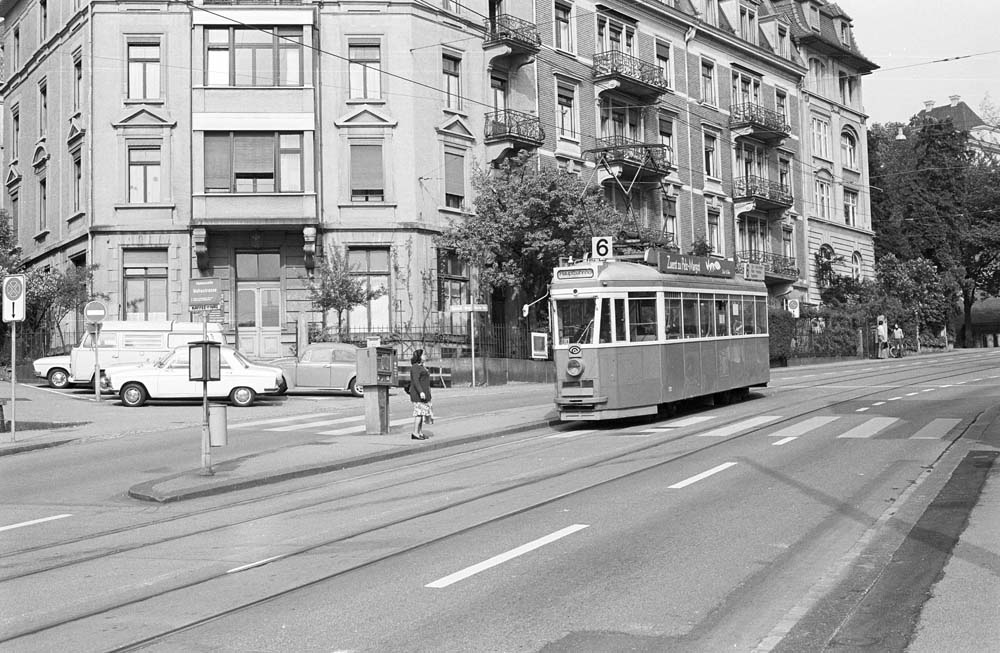 Be 4/4 1531 arrives at the Voltastrasse stop. A stop sign with a small timetable and a rubbish bin, as well as a ticket machine for short or long journeys (there weren’t any other options back then), served as the ‘furnishings’. The stop is slightly offset today, but when I look at Google Street View, the row of houses still exists, even though hardly a stone was left standing in the university quarter. 17 May 1977 Photo: © Edi Meier, Bülach
 Line 6 serves the ETH, the University and the University Hospital and is therefore very busy, particularly in the morning and evening. Once, I saw a tram travelling at full speed with a passenger’s legs trapped in the half-closed doors. Today, that would be monitored and the journey halted…
Just below the ETH, Be 4/4 1533 is making its way uphill. Looking at the photo, the distinctive Opel to the left of the tram caught my eye; the number plate, in particular, looked very familiar… I’ve no idea why I drove my father’s car into the city centre back then… Certainly not to take photos of trams! 7 May 1977 Photo: © Edi Meier, Bülach
 Be 4/4 1532 is travelling downhill on a sunny January morning just below the infamous Gloria bend. The large, classic building behind the ‘Sechser’ has meanwhile been replaced by a new building. On the left, a huge building site would now bear witness to the construction of the new university hospital. And this road would certainly not be car-free! 2 January 1977 Photo: © Edi Meier, Bülach
 The upper terminus is almost in sight. Be 4/4 1530 is just turning into the terminus loop, which winds its way round a cluster of houses. According to Street View, all the houses are still standing, some with a fresh coat of paint. 17 May 1977 Photo: © Edi Meier, Bülach
 Let’s switch to Line 8, which runs from Hardplatz along winding routes to Klusplatz without passing the main station. Be 4/4 1509, from the first series with less powerful engines, is waiting at what was then the terminus, the Hardplatz stop, for its next journey. Since tram line 8 was extended across the Hardbrücke, Hardplatz has been completely redesigned. The houses, however, are all still standing. It is astonishing that there are no cars driving along Hardstrasse in the background, a road that is normally very busy. 4 May 1975 Photo: © Edi Meier, Bülach
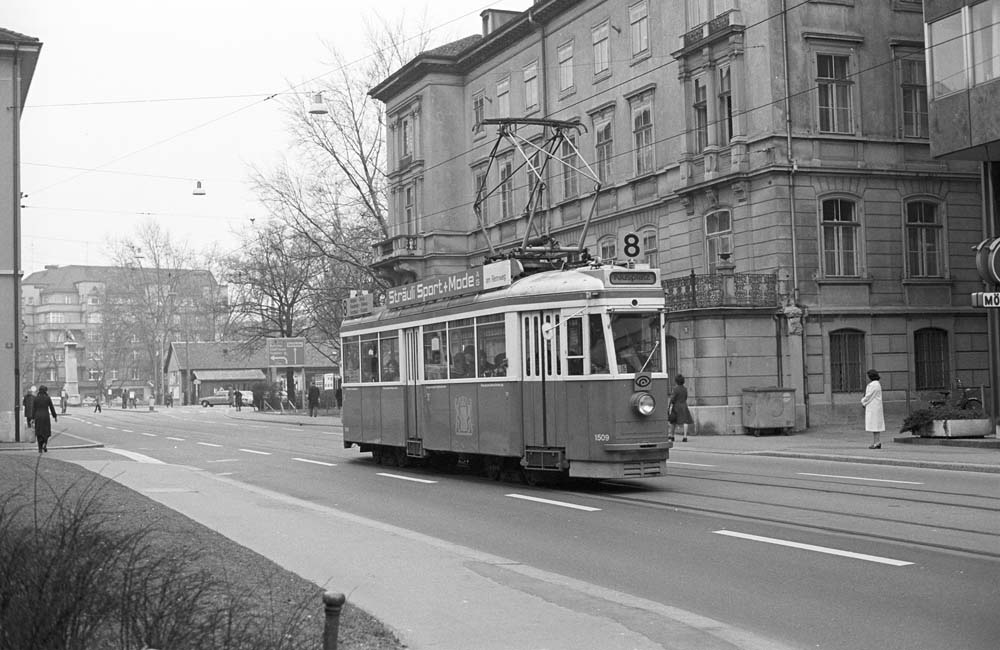 The same Be 4/4 1509 was back in service on Line 8 just under three years later; it has just left the Selnau stop and is continuing towards Paradeplatz – Bellevue – and on to Klusplatz. Everything in the surrounding area has changed here. The building on the right has made way for the prestigious new Stock Exchange building, which, however, is already being used for other purposes. The barracks a little further back have all disappeared. Here, the feeder traffic from the main station to the end of the motorway roars past on two lanes. And, visible on the left, the SZU’s Selnau terminus station has been replaced by an underground station and new buildings. Only the four lions on columns on the bridge over the Sihl still stand stoically in their place… 9 February 1978 Photo: © Edi Meier, Bülach
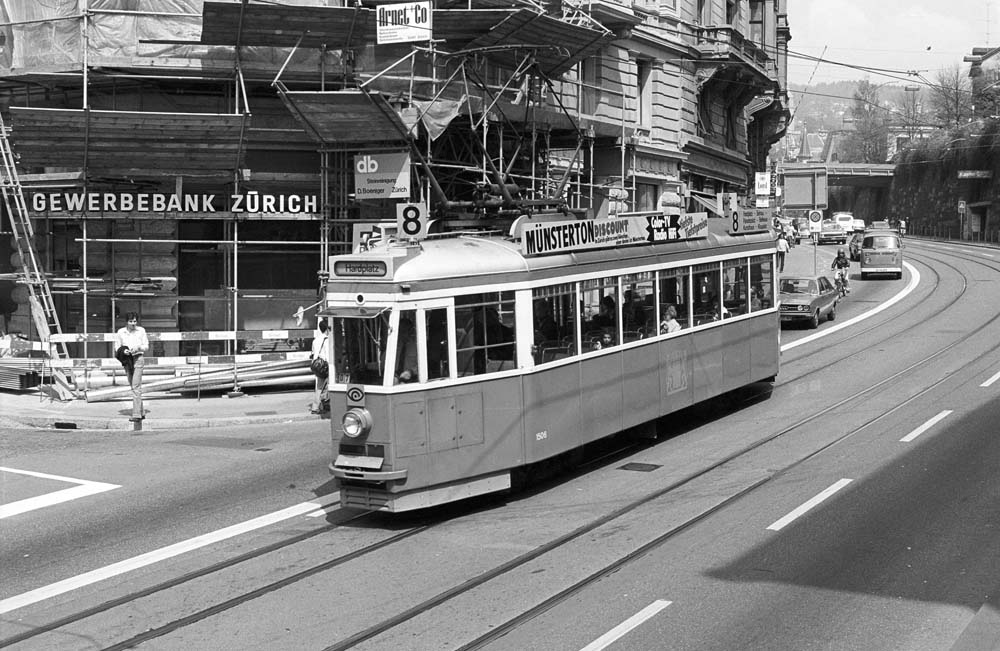 Yes, this is the busy Rämistrasse! These days, you can forget about taking photos here: in both directions, there’s slow-moving or stationary traffic every day… Be 4/4 1506, one of the four trams built by SIG, is heading towards Bellevue. The building behind the tram still stands, but the Gewerbebank Zürich is now a thing of the past. It was taken over by a private bank. 24 October 1978 Photo: © Edi Meier, Bülach
 Be 4/4 1509 (sorry: this one again) is leaving the Quaibrücke and posing in front of the boat landing stage. It is followed by a brand-new pair of Tram 2000 units. Their paintwork is still white right up to the edge of the roof. It was only later that the thin blue stripe was added along the roof edge. I could hardly believe it when looking through the photos: this street without a single distracting car… 9 February 1978 Photo: © Edi Meier, Bülach
 Be 4/4 1507 (also one of the SIG units) leaves the Quaibrücke on 9 February 1978 and pulls into the Bellevue stop. There are neither queuing cars on the bridge nor following one or two tram consists… Even back then, taking good tram photos was a bit of a nerve-wracking business, but compared to today, conditions were heavenly! 9 February 1978 Photo: © Edi Meier, Bülach
 Let’s switch to Line 15, which ran from Oerlikon station to Klusplatz. Here, Be 4/4 1524 is pulling into the square in front of Stadelhofen station. The building was demolished a few years ago following a long dispute, and today a striking structure by the star architect Calatrava stands on this site. Stadelhofen 17 February 1976 Photo: © Edi Meier, Bülach
 Be 4/4 1526 has just passed its counterpart Be 4/4 1522 on the Limmatquai. On this misty day before Christmas, the spires of St Peter’s and Fraumünster are only faintly visible. The buildings on the Schipfe, including the front building housing the Heimatwerk, have been preserved. If I’m not mistaken, even the Christmas tree decorations on the railings overlooking the Limmat remain unchanged… Zurich, Limmatquai near Central 23 December 1976 Photo: © Edi Meier, Bülach
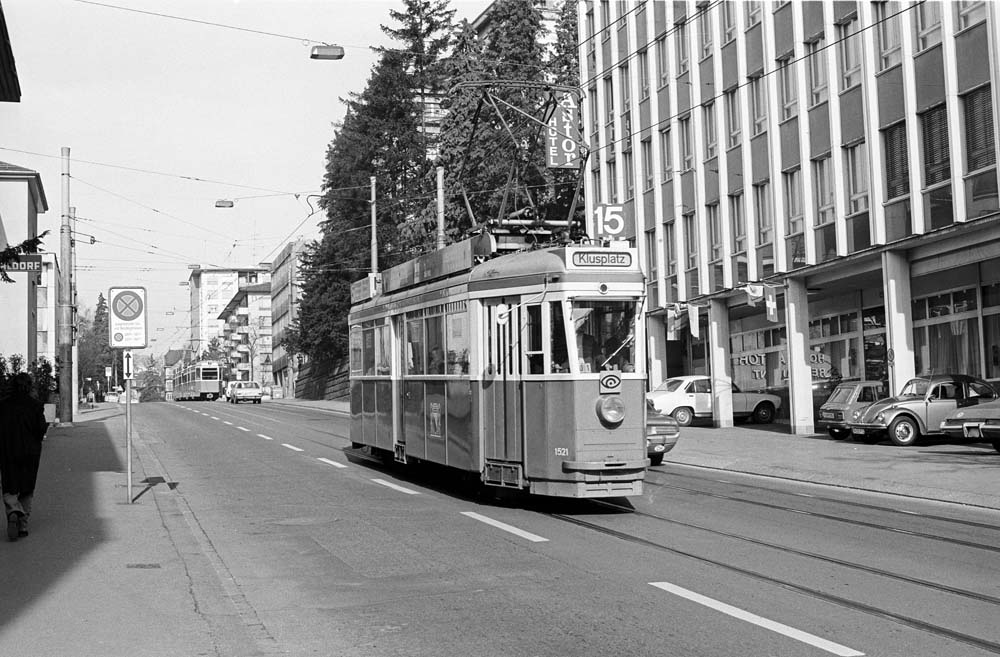 I’ve noted down “Zurich Haldenegg”. After a long search on Google Street View, I found the spot immediately above today’s tram stop. The building on the right, which looks quite new and houses the Hotel Astor, no longer exists. The stone wall, however, can still be seen, though without the tall trees, which is why the older buildings are visible again. The pavement on the left is significantly wider, and the road and tram tracks share the space. This means no one would think of parking there, so the no-parking sign could be removed. Be 4/4 1521 on Line 15 and, in the background, a Mirage double-unit on Line 7. 2 January 1977 Photo: © Edi Meier, Bülach
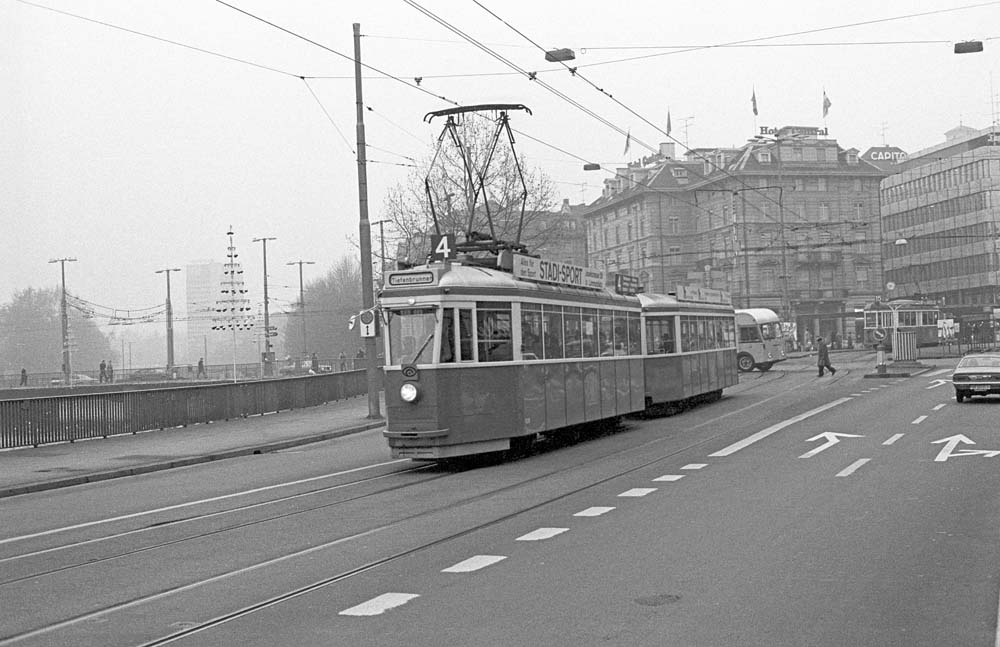 That leaves Line 4 from Hardturm to Tiefenbrunnen, which operates with trailers. On 23 December 1976, Be 4/4 1545 and B 765 have left the Central station and head towards the lake. As there were no significant gradients here, the more powerful second-series Be 4/4 trams were able to haul a B trailer. Behind the B, the distinctive front of a PTT (as the Post Office was known at the time) parcel van can be seen. It will shortly pass the traffic police post, where officers were attempting to keep cars and pedestrians moving in an orderly fashion. Zurich Limmatquai near the Central 23 December 1976 Photo: © Edi Meier, Bülach
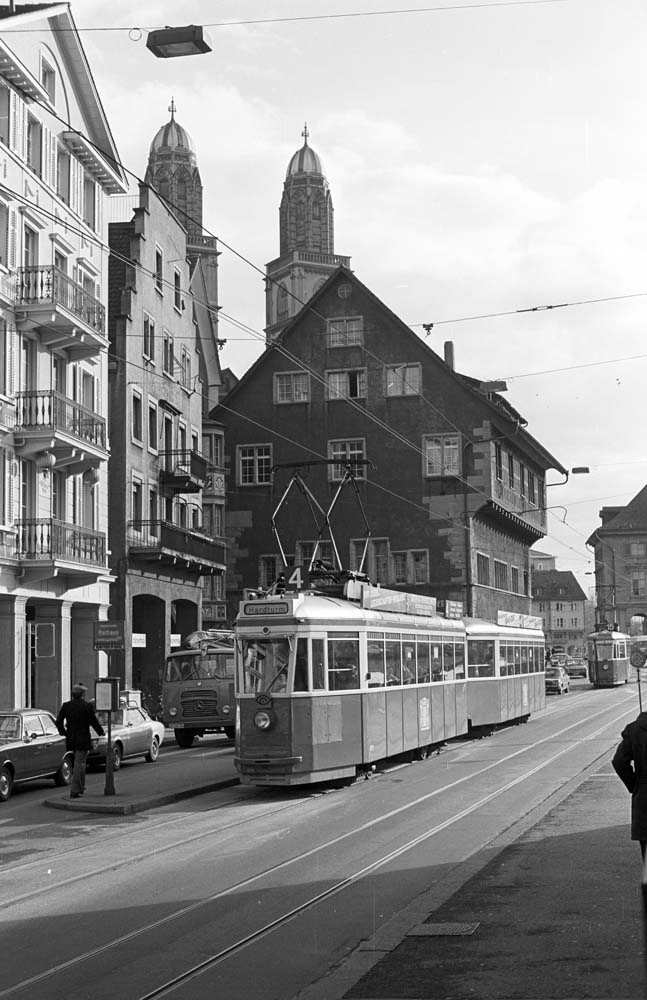 A classic photo spot that’s still possible today: the guild houses (Zur Haue, Zum Rüden) and the Grossmünster on the Limmatquai. Cropped out on the right: the Helmhaus with the Wasserkirche. Only the tram has changed: today, Flexity and Cobras dominate the rail network instead of pedal trams… In the foreground, Be 4/4 1539 with B 759 on Line 4, followed by another tram on Line 15 (even in the close-up, no number is visible…) 27 January 1978 Photo: © Edi Meier, Bülach
 Construction sites aren’t the most attractive subjects for photography. However, they do have one key advantage: there are far fewer cars… Not only is the consist Be 4/4 1522 with B 768 (?) on Line 4 a thing of the past, but so too are the ABM department store (Au Bon Marché), the Foto Hobby Markt and, in the near future, presumably also the Corso cinema (negotiations are still ongoing, particularly in view of the Zurich Film Festival). Incidentally, the Corso House was home to the Zurich flat of the singer Udo Jürgens. 17 February 1976 Photo: © Edi Meier, Bülach
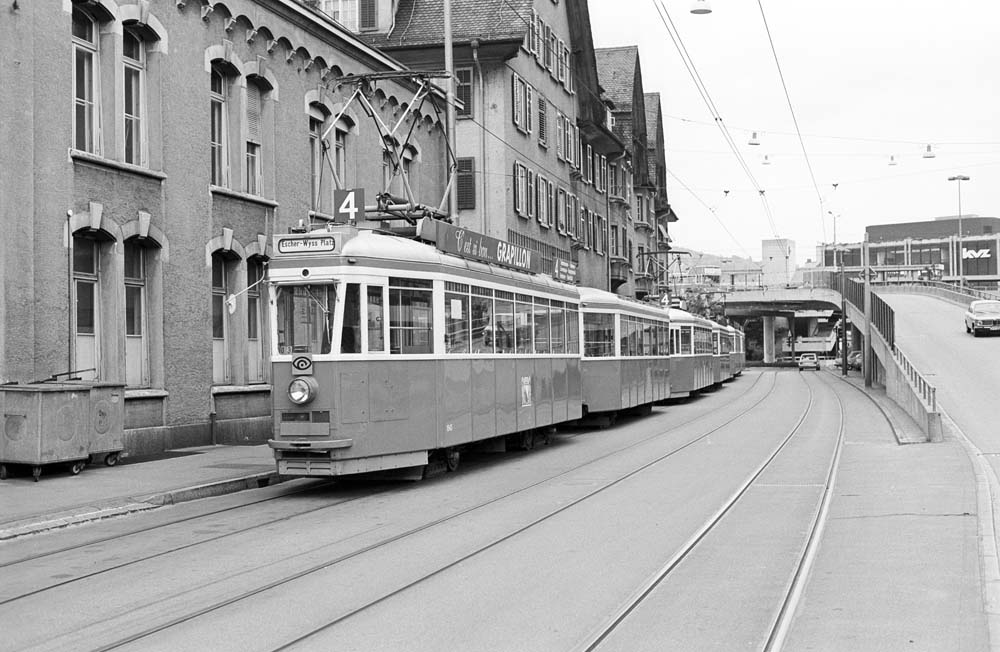 Next to the Escher-Wyss-Platz depot, several Be 4/4 1500 series with B tram sets are parked on 14 June 1977. At the front are Be 4/4 1539 plus B 739. Not only are the ‘Pedaler’ trams a thing of the past, but the entire depot site has been completely redesigned. The gabled buildings still stand due to their listed status, but a new building has been added to them, with residential flats on its roof. Photo: © Edi Meier, Bülach
 The end is nigh: even minor collisions in 1978 were sufficient to see these trams taken out of service. Demolition of Be 4/4 1510 has begun at the Kalkbreite depot. The pantograph and destination display have been removed. Next to it, B 679 awaits its fate… And as we know today: it has survived to this day as a historic vehicle. By contrast, the brick building of the Kalkbreite depot has disappeared, making way for a large-scale development. 21 April 1978 Photo: © Edi Meier, Bülach
Back to railway stories.