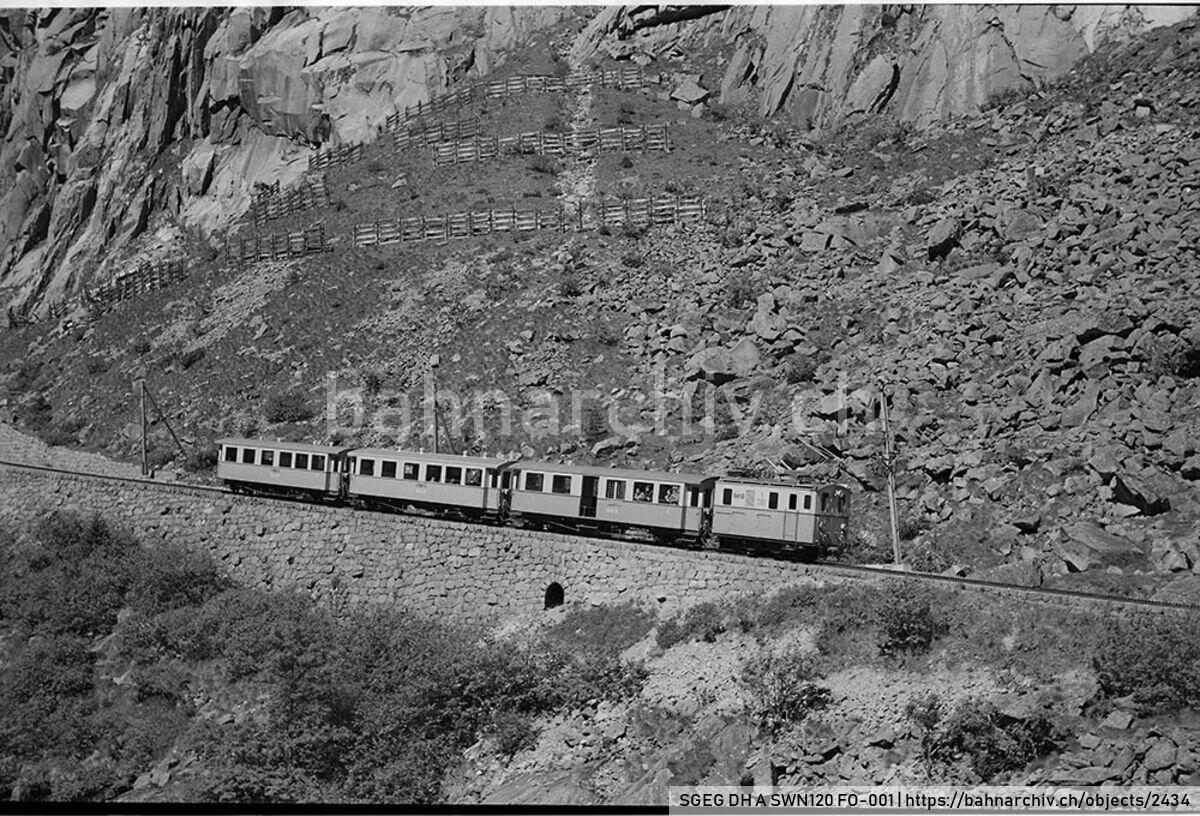
 In keeping with the latest railway news, I searched bahnarchiv.ch for a suitable photo for the header image and came across this brilliant shot by Daniel Heer, although it is not certain whether the Schöllenen Railway had already merged with the FO at the time the photo was taken, or was still operating independently. Photo: (c) Daniel Heer/bahnarchiv.ch, SGEG DH A SWN135 0983-35
Here you will find information about our association, our planned and past excursions into the world of Swiss railway and industrial history, and lots of interesting facts about the world of railways.
The Glacier Express
It’s not particularly original these days to put together a railway feature to mark the 100th anniversary of the Furka–Oberalp Railway. Given the hot weather, I wasn’t feeling very creative, so I set myself what I thought would be a simple topic: the Glacier Express on the Furka mountain route during its final years of electric operation.
Although there are plenty of photos, unfortunately the Glacier Express isn’t always recognisable as such, as the dining car was usually detached at Andermatt and re-coupled to the return train via the Oberalp, meaning it isn’t a reliable identifying feature… read more →
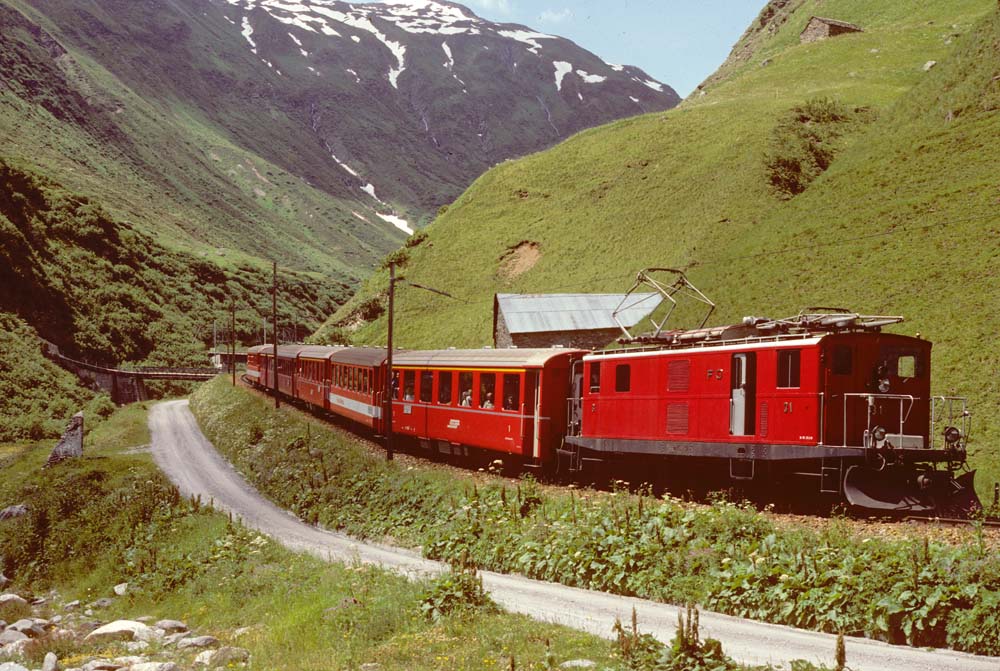 Shortly after leaving Realp station, the first train we encounter is the Glacier Express. On 5 July 1981, it was made up as follows: FO HGe 4/4 31 + RhB A 1253 + FO B 4267 + RhB A 1255 + BVZ B 2285 + FO B 4266 + FO B 4265. This colourful mix of carriages from all three railway companies involved in the Glacier Express – BVZ, FO and RhB – was typical of those years. Realp, 5 July 1981, Photo: © Edi Meier, Bülach
The last years of the Be 4/6 12305
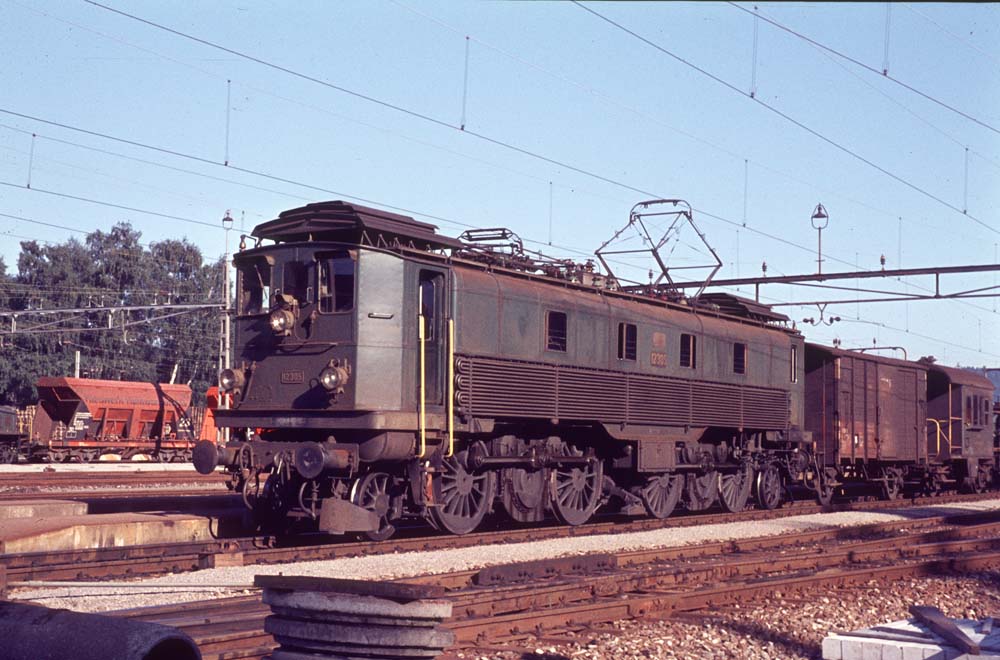 When I first started taking photos of trains, the last Be 4/6 locomotives at Winterthur depot were eking out a living hauling general freight trains such as the 8049 from Zurich to Schaffhausen. During a lengthy stop at Bülach, the Be 4/6 re-formed the train with a lengthy shunting manoeuvre. On 7 September 1970, Be 4/6 12305 stands ready for departure. In the background, a Be 6/8 II with a gravel train is also waiting for the green light. Bülach, 7 September 1970 Photo: © Edi Meier, Bülach
Arth-Goldau
Members and friends of the SGEG who regularly visit our website will probably not be too surprised that we are presenting a piece on railway history to coincide with our next excursion.Everyone is familiar with Arth-Goldau station, either from changing trains there or as the starting point for a trip up to the Rigi. Arth-Goldau is also an important starting point for the Südostbahn. So there is certainly plenty of material for a few look-backs…
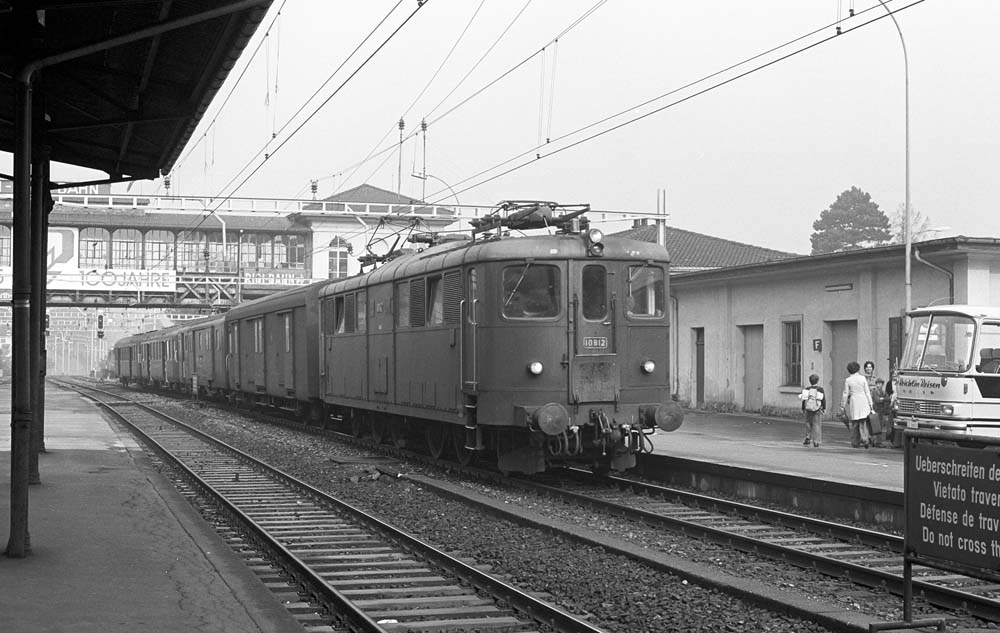 Let’s start with a typical Gotthard locomotive, which was, however, less well known to the general public and rather unpopular with train drivers. The Ae 4/6 10812 is pulling its Lucerne – Erstfeld passenger train 1516 into Arth-Goldau. Above the rear of the train, you can see the Rigibahn’s famous elevated cross-platform station. Behind the locomotive is a (presumably manned) mail van, as was often the case at the time. 30 July 1977 Photo: © Edi Meier, Bülach
OJB B23 Part 2: Passenger Trains
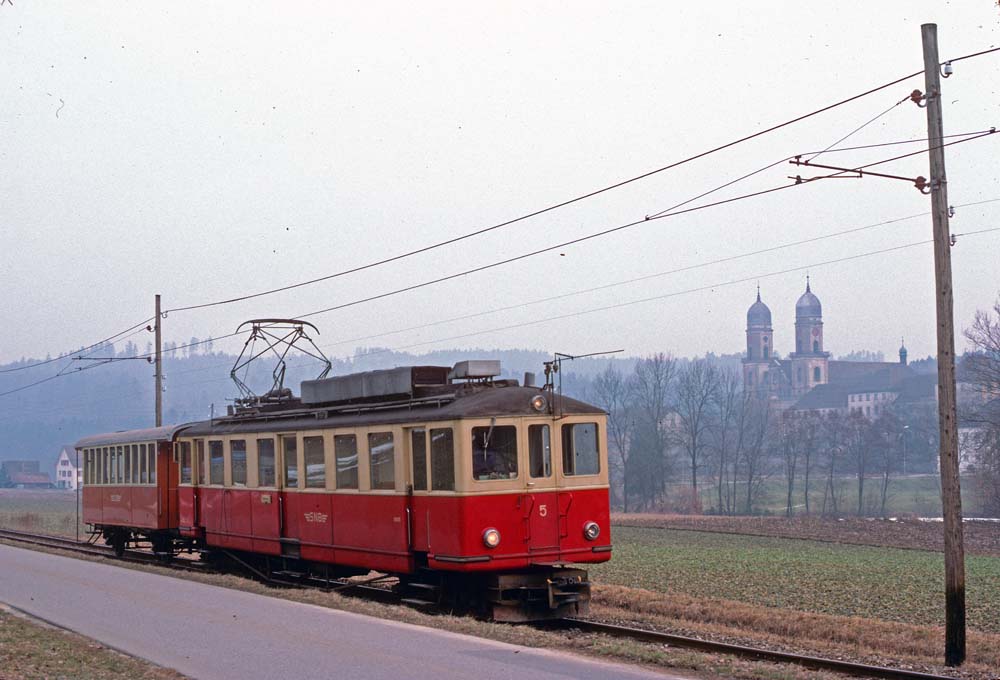 Let’s start modestly with the SNB BDe 4/4 5 and the B 23 in front of the monastery church of St. Urban. The Baroque monastery church, built between 1711 and 1717 on the site of an older church, would of course be well worth a visit, but we didn’t have time for that! The BDe 4/4 5 was built in 1918 by SWS and MFO for the SNB and delivered some three months after the line opened. In 1954, the carriage body was modernised and in 1961 it was fitted with new, more powerful traction motors from SAAS (Sécheron). 24 March 1984 Photo: © Edi Meier, Bülach