Today we would once again like to commemorate a unique locomotive in the SBB fleet: the Ae 4/6 III 10851.
The history of this locomotive began in 1938 as the Am 4/6 1101. BBC had built a gas turbine system for a stationary emergency power unit and wanted to test whether this technology was also suitable for locomotives. The SBB viewed the project favourably and, following a successful test, held out the prospect of taking over the locomotive. The locomotive was built by BBC at its own expense and entered service in 1941.
It achieved positive results in daily operation, particularly with the DB and the SNCF, but had a very low efficiency and thus, compared to conventional diesel locomotives, much higher fuel consumption. The SBB, which had by then electrified almost all its lines, did indeed take delivery of the locomotive as agreed, but could find no suitable area of operation for it. The technology failed to really establish itself worldwide, and so the locomotive was taken out of service as early as 1954 following significant damage and with a mileage of just 410,000 kilometres.
In 1958, the locomotive was rediscovered and converted into a three-system locomotive to serve as a test bed for the planned four-current TEE trains: the Ae 4/6 III 10851. Unfortunately, the conversion did not take place until 1961, by which time the RAe TEE trains had already taken over the rail network, and the Ae 4/6 III was no longer able to provide any practical insights, which naturally reduced the interest of railway officials.
During the conversion of the locomotive by the Zurich Main Workshop and BBC, a new body with driver’s cabs modelled on the Ae 6/6 was mounted on the old underframe, including the bogies and auxiliary systems. As with the Am 4/6 1101, the new electrical equipment was mounted on a frame that was fed into the locomotive through the open roof. For AC operation (SBB 15 kV, 16 2/3 Hz and SNCF 25 kV, 50 Hz), a transformer with multiple taps was fitted, and the AC current was then rectified via a silicon rectifier. The DC current generated in this way could be used in the same way as for operation on 1500 V DC, allowing the original DC motors to continue in service.
Following its commissioning on all power supply systems, the Ae 4/6 III 10851 was assigned to the Geneva depot for service on the Geneva–La Plaine line, which was operated by the SNCF at 1,500 V DC. There, it was to serve as a replacement for the two DC shuttle trains, the BDe 4/4 II + ABt.
 I first came across the Ae 4/6 III 10851 on 30 September 1970 in the Zurich main workshop, amidst pouring rain. The second time was on 11 August 1972 in Yverdon…
Visits to the workshop were not unusual, as this locomotive was, after all, a test vehicle and was deliberately breaking new ground. Furthermore, unlike with production locomotives, there were no large spare parts stocks available for this one-off. And as it was rarely in service anyway (one of the two BDe 4/4 II shuttle trains was sufficient for the regular Geneva–La Plaine service), there was little pressure for fewer and quicker repairs. Zurich, 30 September 1970 © Photo: Edi Meier, Bülach
 Then, in 1977, an opportunity for operational photos suddenly arose. I knew that one of the two regular railcars was in the workshop for an extended period and that the remaining railcar regularly had to be taken out of service for a few hours for minor maintenance. On 27 September 1977, the time had come once again, and I travelled on the first train from Zurich across Switzerland to Geneva… 27 September 1977 © Photo: Edi Meier, Bülach
 To my great delight, the Ae 4/6 III 10851 was indeed standing at the head of the typical replacement formation, comprising a D3 luggage van and two of four DC-compatible light-steel carriages with intermediate access (series B 50 85 29–30 500 … 503), on the outermost track, ready for the journey towards La Plaine. Geneva 27 September 1977 © Photo: Edi Meier, Bülach
 I boarded the train and travelled on to La Plaine, where the locomotive had to be uncoupled for a shunting manoeuvre. Although La Plaine means ‘the plain’, the backdrop with the steep vineyard doesn’t really fit the name… It would look quite different from the photographer’s perspective!
Cropped on the left the toilet block with the enamel sign ‘HOMMES’, intended for male toilet guests. La Plaine 27 September 1977 © Photo: Edi Meier, Bülach
 On the through track for SNCF trains, the Ae 4/6 III 10851 returned with the shunter positioned beneath the driver’s cab door.
Although at first glance it could be mistaken for an Ae 6/6, it had little in common with it. Whilst the Ae 6/6 has two three-axle bogies, this locomotive had the special axle arrangement (1A)Bo(A1), which means that on both sides, an outside running axle and a driving axle were combined in a single bogie, whilst the remaining two driving axles were permanently mounted centrally beneath the locomotive. La Plaine, 27 September 1977 © Photo: Edi Meier, Bülach
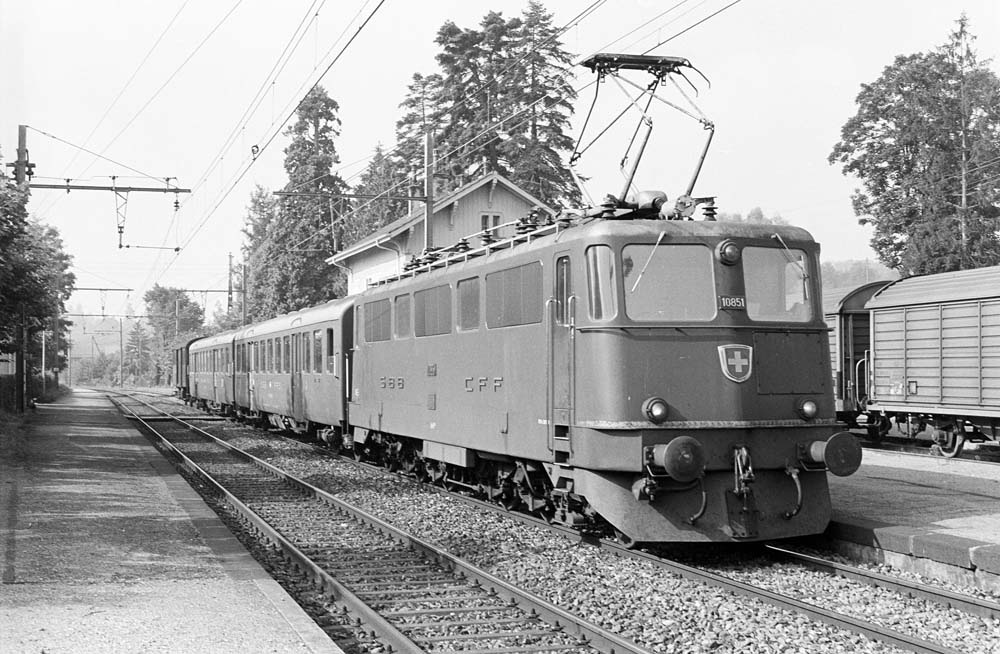 I had to travel by train and got off at Satigny on the return journey. On one side stood a small station building; the opposite side had to make do with a wooden shelter…
The Ae 4/6 III had a relatively modest power output of 1,692 kW (2,300 PS) (Ae 6/6: 4,300 kW / 5,830 PS), which is roughly equivalent to an Ae 3/6 I, and a top speed of 110 km/h. Satigny 27 September 1977 © Photo: Edi Meier, Bülach
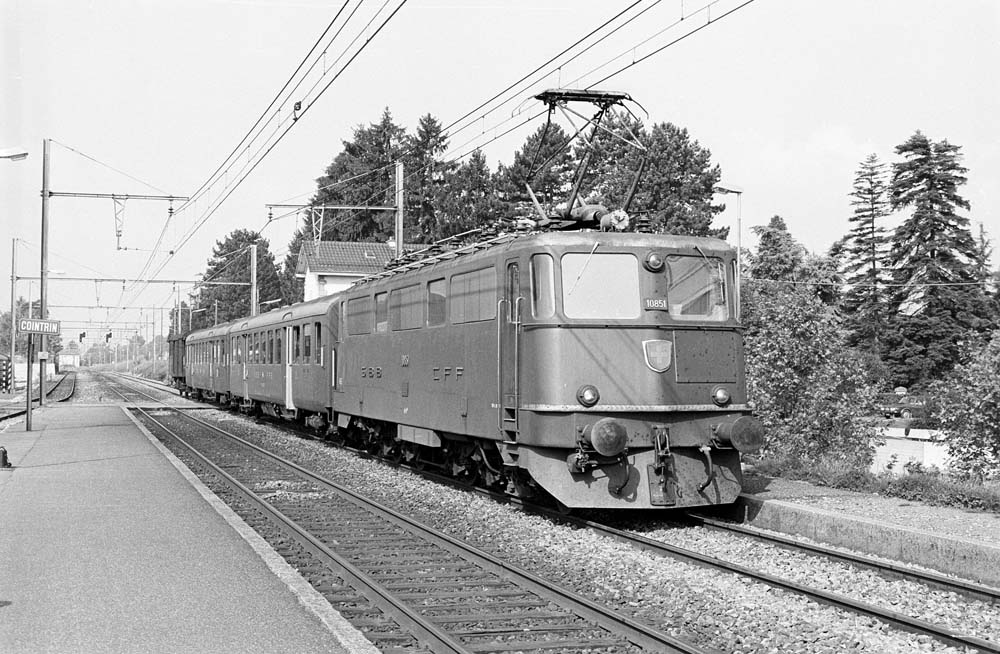 The next photography was taken at Cointrin station, near Geneva Airport, which bore this additional name at the time. I tried to locate this station on the 1976 map and think it is now called Vernier. Be that as it may: it certainly doesn’t look quite so rural here anymore! From the stop to the airport terminal, there was a walk of around 1 kilometre. And there were no wheeled suitcases back then… Cointrin 27 September 1977 © Photo: Edi Meier, Bülach
 The Ae 4/6 III 10851 entering Meyrin station. Instead of caravans, the backdrop here today would be a large car park in front of several buildings.
The front pantograph, which complies with SBB standards, is of course never raised under 1,500 V DC. The rear one, however, with its wider rocker arm, is in contact with the catenary.
Due to its modest technical specifications – and probably also because only a few engine drivers had been trained to operate this locomotive – it was rarely used on SBB catenary lines. Meyrin, 27 September 1977 © Photo: Edi Meier, Bülach
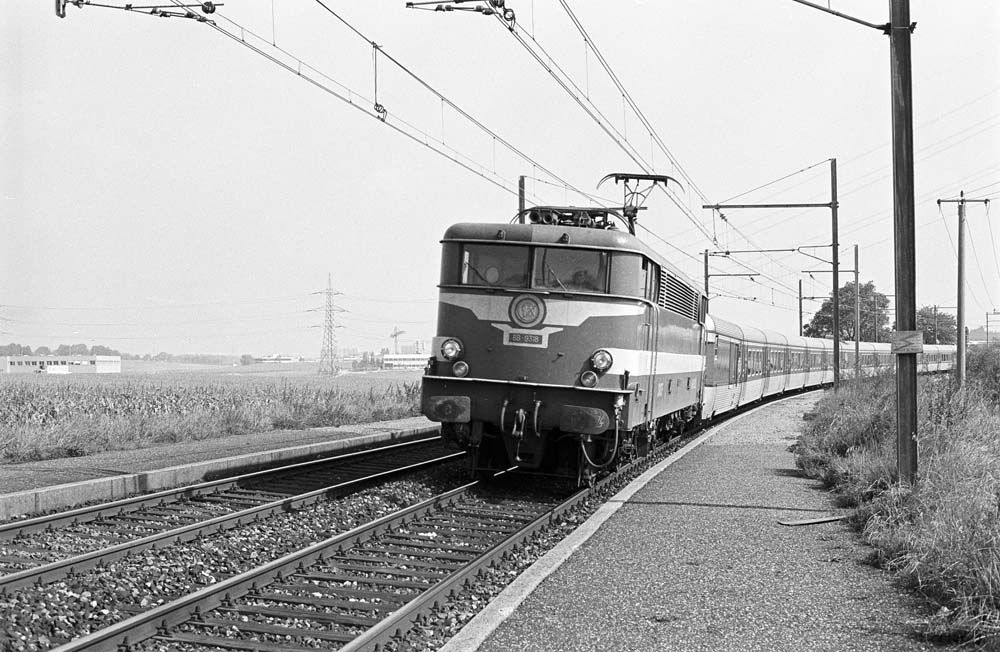 Insiders claim that I only have photographs of Swiss railways (and they’re not entirely wrong about that). Here, however, is an opportunity to prove the opposite: whilst I was waiting in Bourdigny, the BB 9318 rushed past me somewhat unexpectedly with the Catalan Talgo articulated train, which is why the framing of the photo isn’t ideal. Bourdigny 27 September 1977 © Photo: Edi Meier, Bülach
 The Bourdigny stop is rather pretty, situated on a bend.
Compared to the Ae 6/6, the round buffers are striking. This was possible because the Ae 4/6 III, at 16,340 mm in length over buffers, was a good 2 metres shorter, resulting in less overhang.
In 1976, the locomotive’s transformer suffered significant damage; it was removed and replaced with ballast. At the time these photographs were taken, the locomotive could therefore only operate on 1,500 V DC… Bourdigny 27 September 1977 © Photo: Edi Meier, Bülach
 … and because it took a while for the Ae 4/6 III 10851 to return, I also had the chance to photograph an SNCF freight train hauled by the BB 25185. Thanks to the barrier, I was given plenty of warning this time, so the framing is better. The position of the pedestrian is noteworthy: behind the level crossing barrier… Bourdigny 27 September 1977 © Photo: Edi Meier, Bülach
 Despite the bend in the track, I was still able to capture the station buildings in the frame for this short train. Of particular interest is the small telephone box, which was otherwise only found next to signals on open track and enabled contact to be made with the next station.
The Bourdigny station is closed today. 27 September 1977 © Photo: Edi Meier, Bülach
 To finish, here’s another colour photograph from La Plaine showing the train ready to depart – one I’d skipped in the black-and-white series above and which was also taken during that first journey. I only had one camera at the time and had to change the film quickly for this slide. That’s why only this colour photograph survives…
The Ae 4/6 III 10851 was taken out of service and scrapped just two years later following a defect. La Plaine 27 September 1977 © Photo: Edi Meier, Bülach
Back to railway stories.