In the railway history feature dated 30 September 2023, we reported on the transfer of the OJB (Oberaargau–Jura Railway) B 23 from Oensingen to Langenthal. It was to be prepared at the Langenthal workshop for our planned photo trip, and as promised at the time, here are some pictures from that day.
For our photo trip on 24 March 1984, the OJB completely closed the section of track between St. Urban and Melchnau, which had already been taken out of service for passenger traffic at that time and was only still used for freight. With a total of nine vehicles, we put together almost 30 different train formations over the course of the day. Carriages or the railcar were swapped not only at Melchnau and St. Urban, but usually also at Untersteckholz. We’re dividing the day into several stories so it doesn’t get too long. Let’s start with the purely passenger trains…
We had the SNB (Solothurn – Niederbipp – Bahn) BDe 4/4 4 and BDe 4/4 5 railcars at our disposal for the whole day. Added to these were the two B 17 and B 20 cars, still used as reserves, and of course ‘our’ B 23. Freight wagons were also available, which will be presented in the third part. Unfortunately, a bad-weather front moved in faster than the weather forecasts had predicted and covered the sky. Furthermore, there was a sudden onset of winter just before the trip, so the meadows were brown rather than green. On the other hand, this meant we could walk across all the agricultural land without causing any damage. Unfortunately, however, the slides do not show the colours as we would have liked…
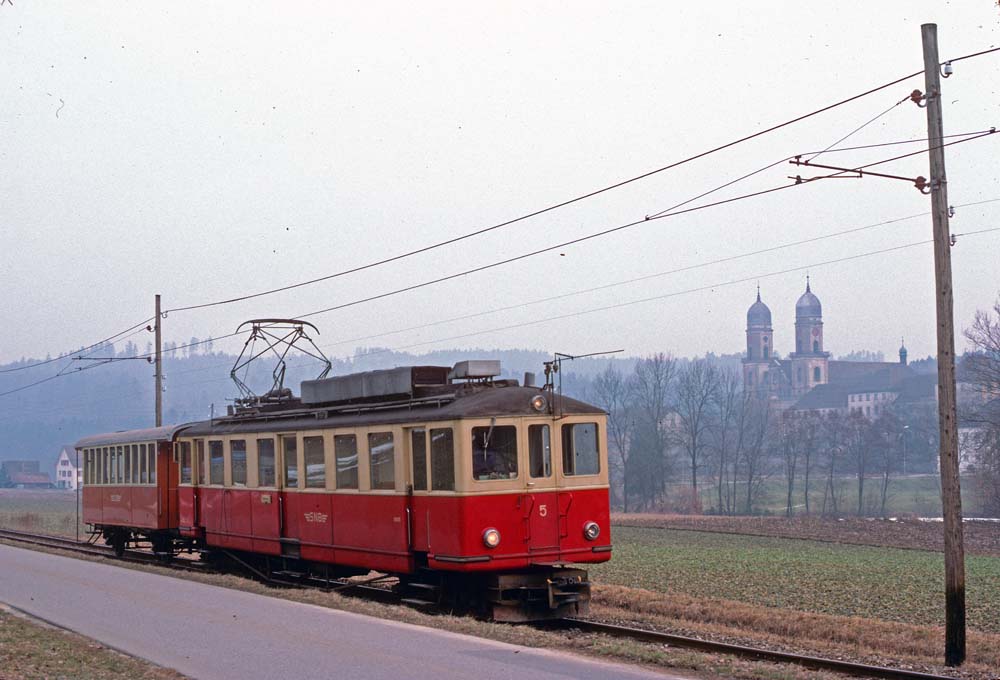 Let’s start modestly with the SNB BDe 4/4 5 and the B 23 in front of the monastery church of St. Urban. The Baroque monastery church, built between 1711 and 1717 on the site of an older church, would of course be well worth a visit, but we didn’t have time for that! The BDe 4/4 5 was built in 1918 by SWS and MFO for the SNB and delivered some three months after the line opened. In 1954, the carriage body was modernised and in 1961 it was fitted with new, more powerful traction motors from SAAS (Sécheron). 24 March 1984 Photo: © Edi Meier, Bülach
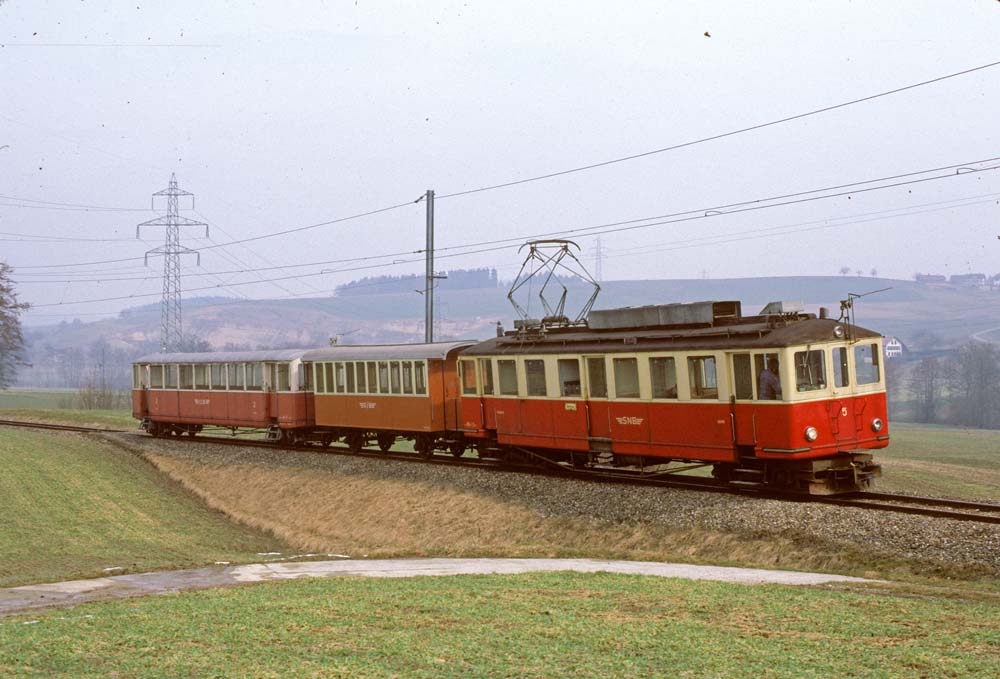 The SNB BDe 4/4 5 is travelling uphill with the B 23 and the B 17 above Untersteckholz. The B 17 was built in 1910 by SWS for the Birsigtalbahn (BTB) as B 59 and purchased by the OJB in 1966. As the B 23 was already taken out of service in 1967, it is quite possible that this is the first time they formed a train together… 24 March 1984 Photo: © Edi Meier, Bülach
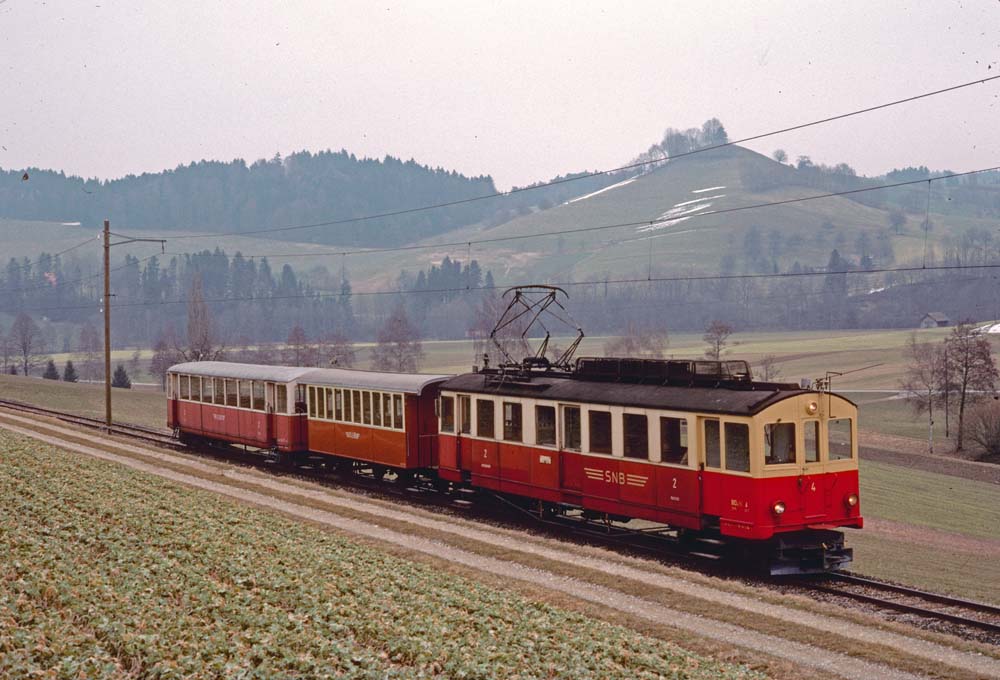 The SNB BDe 4/4 4 also looks good alongside the B 23 and the B 17 on an uphill journey shortly before arriving in Melchnau. Like railcar no. 5, the BDe 4/4 4 was procured by the SNB from SWS and MFO and was already in service when operations began in 1918. It was modernised in 1953 and fitted with wider driver’s cabs. In 1963, it too was fitted with new traction motors from SAAS (4 x 10⁵ hp instead of 4 x 70 hp). 24 March 1984 Photo: © Edi Meier, Bülach
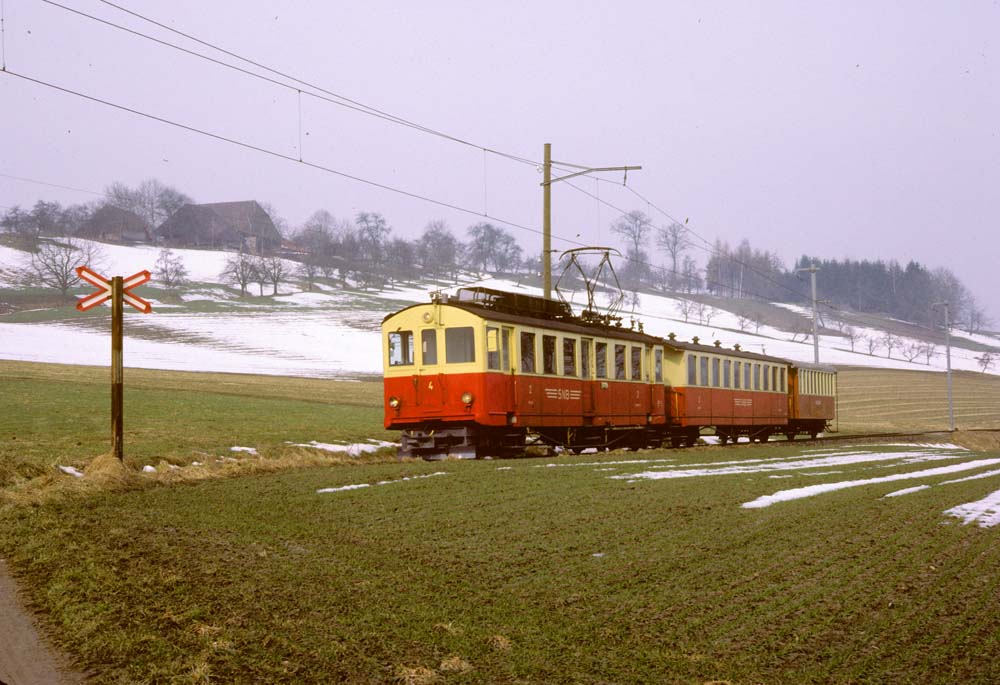 The SNB BDe 4/4 4 was also sent on its way with the other passenger car, the SNB B 20, and the B 23. Here it is pictured at the level crossing above Untersteckholz, which was guarded only by a St Andrew’s cross. The landscape in the background is still covered in snow towards the end of March. 24 March 1984 Photo: © Edi Meier, Bülach
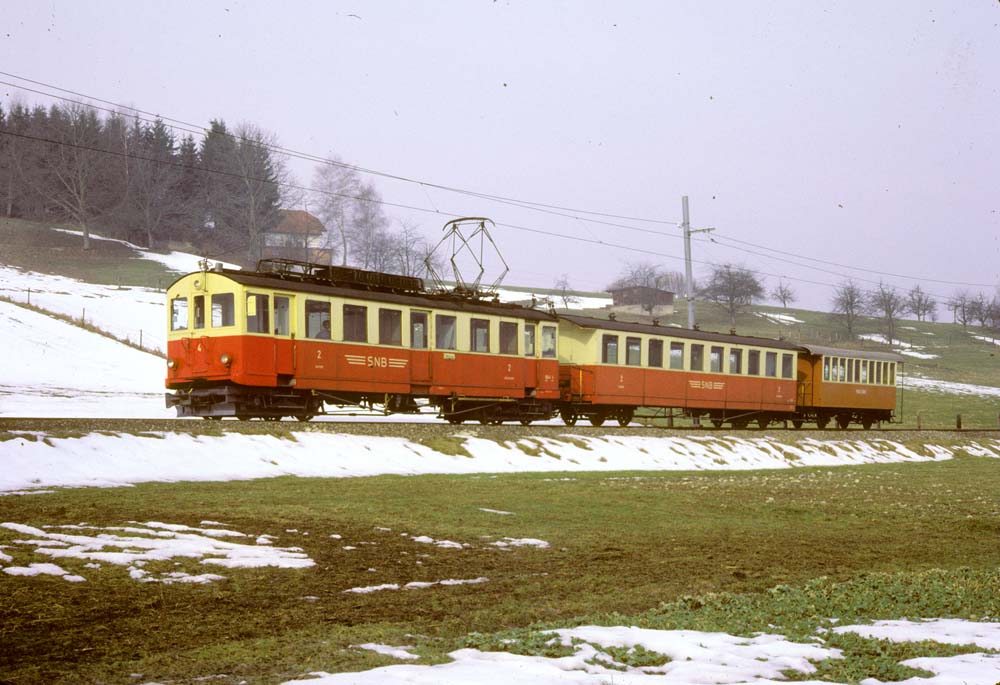 The same train comprising the SNB BDe 4/4 4 + SNB B 20 + OJB B 23 below Melchnau. The B 20 was built in 1920 by SWS for the SNB. It was later converted into a heritage vehicle and could be booked together with railcar no. 1 for special trips. Incidentally, we did not use railcar 1 on the photo trips, as it had recently been repainted orange. 24 March 1984 Photo: © Edi Meier, Bülach
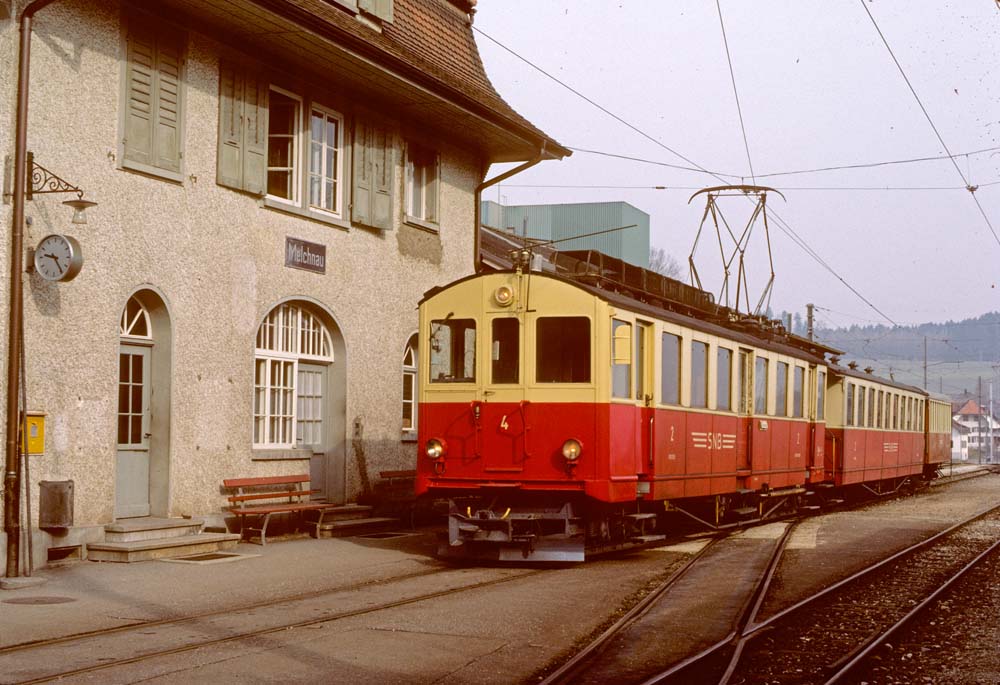 The train comprising the SNB BDe 4/4 4 + SNB B 20 + OJB B 23 has reached its terminus at Melchnau. The approximately 11-kilometre-long line was built by the Langenthal – Melchnau – Bahn (Railway) (LMB) and opened in 1917, already operating on electric power. The imposing building bears witness to earlier times and the high hopes that people in Melchnau associated with the construction of the railway. 24 March 1984 Photo: © Edi Meier, Bülach
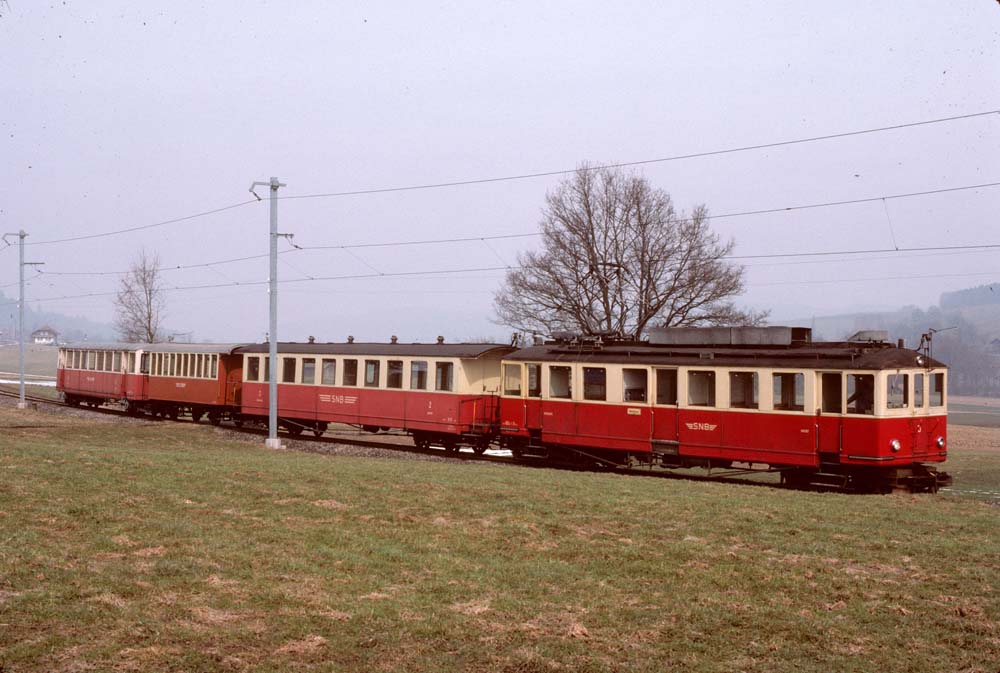 Of course, it can go on a bit longer: after all, we had three passenger carriages at our disposal… The SNB BDe 4/4 5 + B 20 + B 23 + B 17 now has to work hard. Note the simple, crooked overhead line supported by a iron strut on 24 March 1984. Photo: © Edi Meier, Bülach
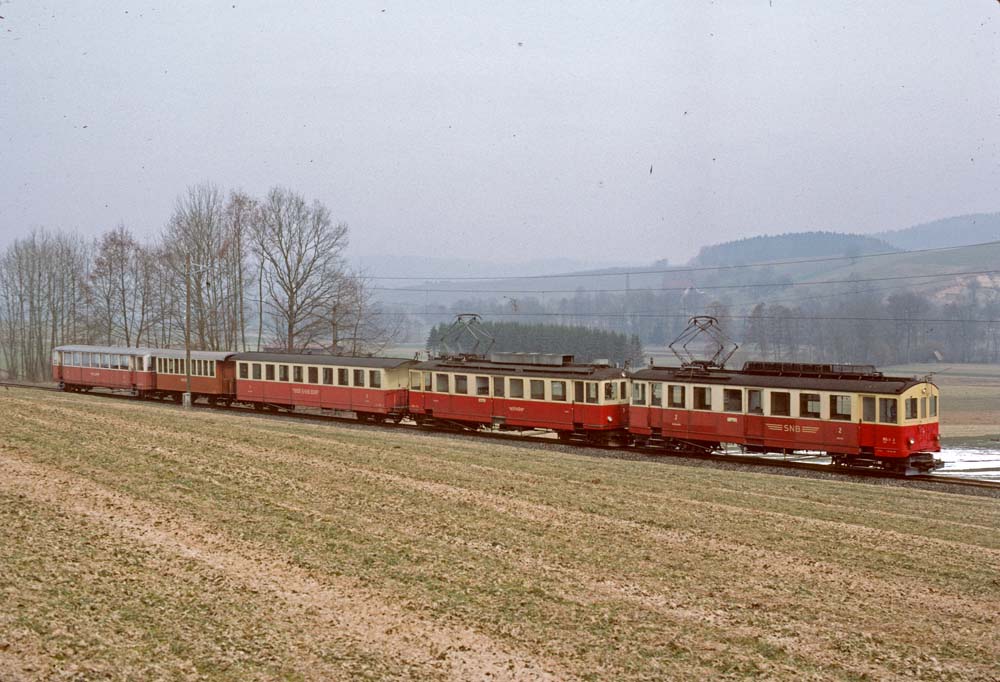 Trains this long with double heading were probably a very rare sight on the line to Melchnau (if ever…). And yet this formation, comprising the SNB BDe 4/4 4 + BDe 4/4 5 + B 20 + B 23 + B17, naturally delights every railway enthusiast’s heart! The long train poses in the early spring landscape just below Melchnau. 24 March 1984 Photo: © Edi Meier, Bülach
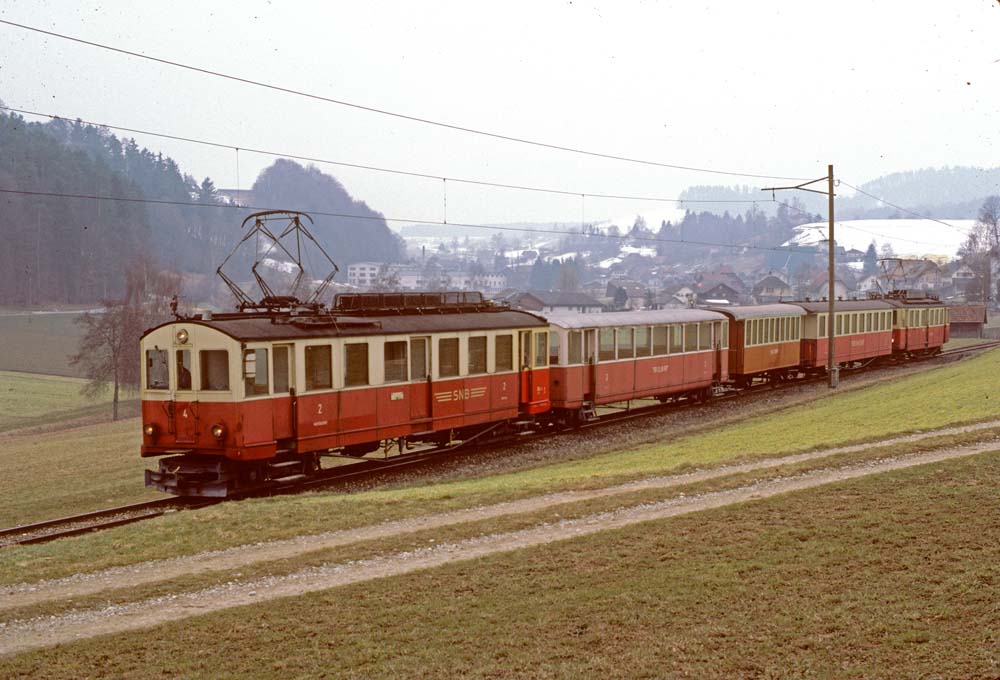 In 1975, the Cyclo-cross World Championships in Melchnau provided an occasion for truly long trains. The two carriages B 17 and B 20 were also used there, sometimes with railcars at the front and rear. This meant they could avoid having to turn round at the terminus and head straight back. That gave us the idea to recreate the same thing: the SNB BDe 4/4 4 + B 17 + B 23 + B 20 + BDe 4/4 5 have just left Melchnau. 24 March 1984 Photo: © Edi Meier, Bülach
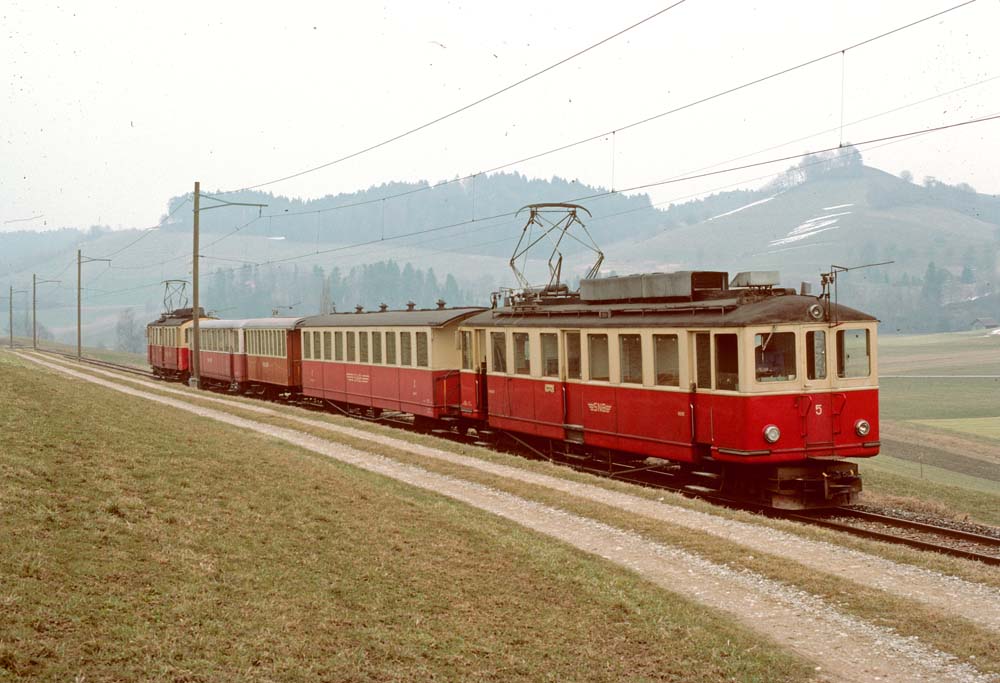 The same train from the other side: the BDe 4/4 5 + B 20 + B 23 + B 17 + SNB BDe 4/4 4 below Melchnau. Despite consulting the geological atlas, I cannot say with certainty whether the striking, uniform hill above the railcar is a drumlin from the Ice Age or simply happens to have a similar shape. 24 March 1984 Photo: © Edi Meier, Bülach
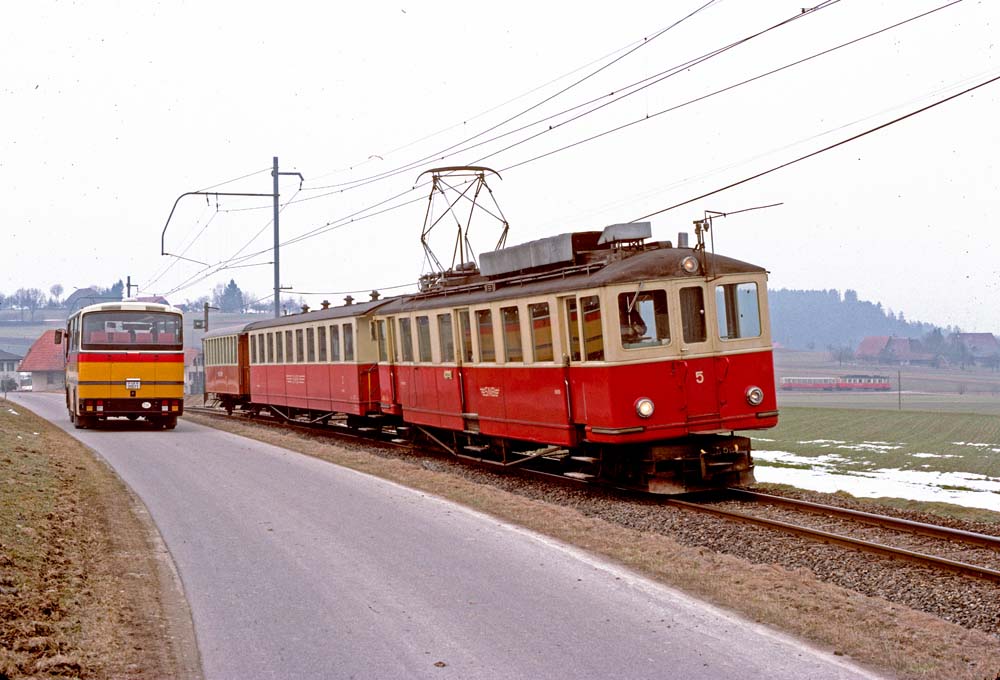 The BDe 4/4 5 with the B 20 and the B 23 poses above Untersteckholz. Whilst the photographers eagerly began snapping away, I relayed instructions via radio to the train crew, which earned me the odd puzzled look… My instructions were for the second train, comprising the BDe 4/4 4 and the B 17, which was leaving Untersteckholz station heading downhill, thus allowing us to capture a staged train crossing. The fact that the rail replacement service, in the form of a post bus, also appeared in the picture was a complete coincidence… 24 March 1984 Photo: © Edi Meier, Bülach
Comments and additions to this railway history can be sent to EG at sgeg dot ch, or use the form to our Vice President Edi Meier. Thank you for your help.
Back to railway stories.