Once again, our technical presentation on transporter bogies (rollbocks) and carrier trucks attracted a full house and eager listeners. After a welcome address by SGEG President Roger Bennet, our speaker Werner Hardmeier quickly took the floor.
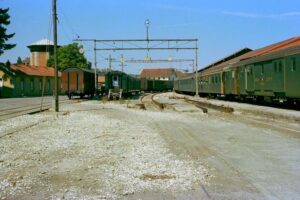
Werner began his presentation in the far west, more precisely at Geneva Cornavin, where the Geneva tramway was the first Swiss railway to transport standard-gauge freight cars on bogies from 1896 onwards. This ended in 1955, but traces of the transhipment facility could still be found in the 1970s. From there, the presentation jumped from west to east, from railway to railway.
BAM Bière – Apples – Morges
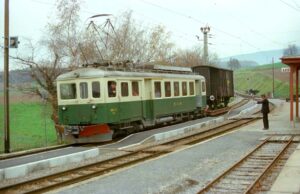
BAM started in the 1960s with carrier trucks, as this striking photo shows. The stationmaster waves the train off with his trowel.
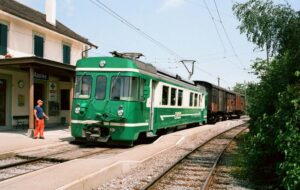
Traffic increased and the railway responded by purchasing three powerful railcars nos. 11 to 13 and switching to transporter bogie operation. The railcars had a massive coupling device at the front…
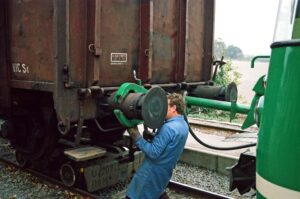
…which can be seen here in use. Do the buffers really appreciate this kind of force?
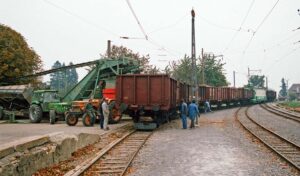
There is a lot of traffic, especially during the sugar beet harvest. Loading sugar beets with conveyor belts at a station.
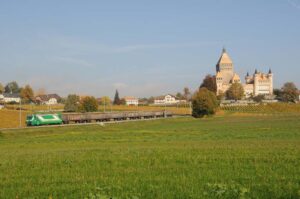
With two new locomotives, transporter bogie operation continues to this day.
In recent years, on the main loading days of the sugar beet harvest, rail operations have been switched to buses during the day. The beet is loaded on the mainline track with the catenary switched off, and a small diesel tractor at the end of the train slowly moves the train as soon as a wagon is full (only downhill…).
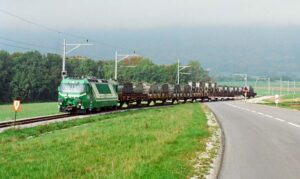
A long connecting track was even built for the army at the Bure military training area.
YSC Yverdon – Ste-Croix
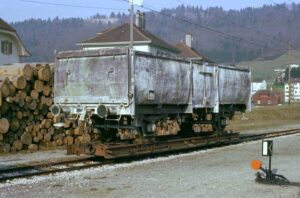
The YSC started very early with carrier truck operation for the transport of agricultural products and timber. However, due to the narrow tunnels, only the lower section of the line as far as Baulmes could officially be served. This photo proves that open freight wagons with reduced requirements for the clearance gauge also made it to Ste-Croix.
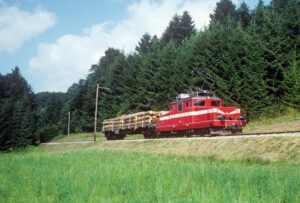
From 1973 onwards, the company switched to transporter bogie operation. In addition to simplifying operations, this meant that covered wagons could now also be used to reach Ste-Croix. However, these were mostly vehicles for transporting timber.
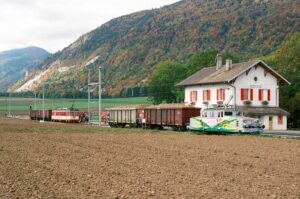
Similar to the BAM, freight transport was particularly concentrated in the autumn sugar beet harvest season. During this period, several locomotives could be seen in operation. In addition to the Ge 4/4 21 freight locomotive, these were mainly the new railcars, which were identical in construction to those of the BAM, but without a coupling device spoiling the front end.
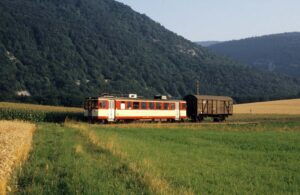
The use of a series 4 or 5 railcar was rather rare. Less rare, unfortunately, was thick fog in autumn…
Today, the use of transporter bogies has been discontinued.
CJ Chemins de fer du Jura
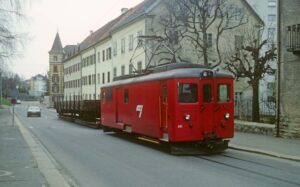
CJ started carrier truck operations in 1915 from La Chaux-de-Fonds to Saignelégier and has remained faithful to the system to this day. After loading at La Chaux-de-Fonds, the wide wagons first had to navigate the narrow streets of the town. After the Saignelégier–Glovelier line had been re-gauged, another loading facility was added in Glovelier, which is now the only transhipment option.
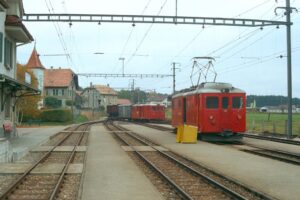
In 1953, CJ purchased three locomotives with the same electrical equipment as the eight railcars. These handled freight transport for a long time. Later, they were supplemented with second-hand vehicles from the Chur–Arosa Railway and the Frauenfeld–Wil Railway. One of the locomotives was modernised with new electrical equipment. The transport of timber and waste generates a very high volume of traffic.
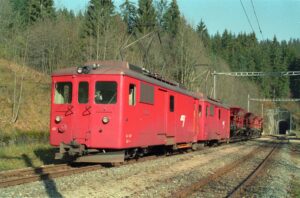
The CJ also operates a standard gauge line and owns a few gravel wagons there. These are not only used on the narrow gauge line on rollers when gravel is needed, but are also frequently parked there, remaining on the rollers.
GFM Chemins de fer fribourgeois Gruyère – Fribourg – Morat
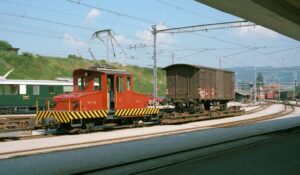
The GFM started its carrier truck operation in 1955 with second-hand vehicles from Geneva. It already had a busy freight service and therefore owned two two-axle shunting locomotives, Te 2/2 11 and 12. In addition, there were two four-axle locomotives, Te 4/4 13 and 14, which had been built in-house on underframes and with parts from scrapped passenger railcars.
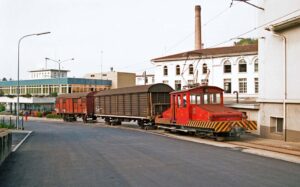
The main traffic was on the Bulle–Broc section, where many wagons were delivered to the chocolate factory. Due to the steep ramp down to Broc Fabrique, the most powerful locomotives, ABe 4/4 115 and 121, always had to be used, occasionally assisted on the return journey by the Te 4/4 13, which was stationed in Broc for shunting work, parfois assistées au retour par la Te 4/4 13 stationnée à Broc pour les manœuvres.
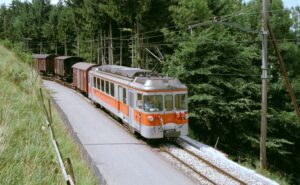
When the two new railcars 141 and 142, which had been purchased for gravel traffic, became available, they were frequently used between Bulle and Broc, as shown here on the steep ramp down to Broc. Later, GFM even purchased two new GDe 4/4 freight locomotives, which were identical in construction to the MOB’s 6000 series.
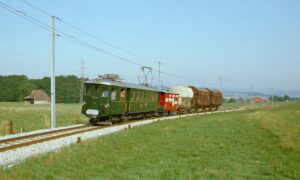
The most powerful old railcar, Be 4/4 121, continued to be used on the Palézieux – Châtel-St-Denis section after being replaced by newer vehicles. Due to the compressed air brakes, a narrow-gauge compressor car was used for the rollbock operation that had been introduced in the meantime.
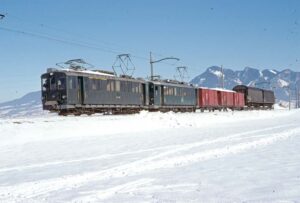
Very rarely, older railcars were also used, either for transporting empty rolling stock or because they were so photogenic for a photo trip.
MOB Montreux – Berner Oberland – Bahn
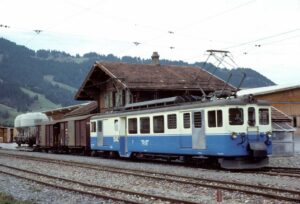
Starting in 1913, the neighbouring MOB operated a transhipment facility in Zweisimmen and mainly served the branch line to Lenk from there, while the carrier trucks were able to reach Saanen on the main line.

During the reconstruction of the Lenk branch, railway photographers were delighted to see railcars 25 and 26 in use.
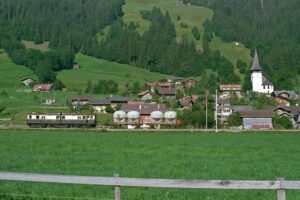
The MOB also purchased several transporter bogies with vacuum brakes. Werner Hardmeier was never able to observe them in use. Only those with compressed air brakes were successful, and the DZe 6/6 2001 and 2002 articulated locomotives could often be seen in use with them. A special feature is the very long rod connecting the traction vehicle and the transporter bogie.
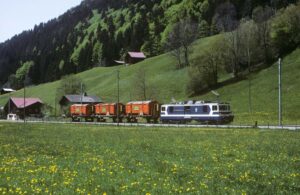
The MOB also benefited from waste transport, for which newer GDe 4/4 6000 vehicles were sometimes used.
BTI Biel – Täuffelen – Ins – Bahn

The BTI was one of the pioneers in the use of carrier trucks. However, its own aging vehicles disappeared relatively early on, as it was able to purchase several more powerful second-hand railcars from the SZB. The transhipment station was located at Ins.
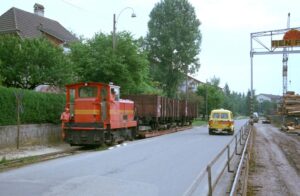
There was another narrow-gauge line in Biel that used carriers, but it had no connection with the BTI. As a relic of the early closed down Biel – Meinisberg railway, the Vereinigte Drahtwerke and the Renfer wood impregnation plant continued to be served by narrow-gauge tracks and operated with carrier trucks..
SNB Solothurn – Niederbipp – Bahn
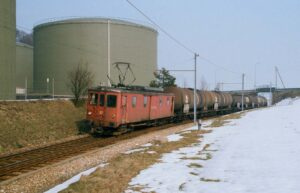
The SNB was also able to acquire a second-hand railcar from the SZB: the powerful De 4/4 52 vehicle was too long and unwieldy for the SZB, but proved its worth at the SNB, especially on the three-rail track from Niederbipp to Oberbipp at the head of heavy oil trains. Thanks to the asymmetrically mounted buffers and the screw coupling, standard gauge carriages could be easily attached despite the different track widths.
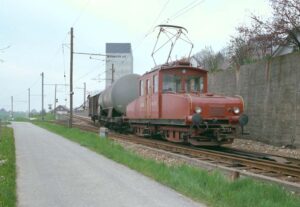
The slow Ge 4/4 57 was available as a replacement vehicle, which hardly ever happened, so that a photo trip had to be arranged to capture it.
OJB Oberaargau – Jura – Bahnen
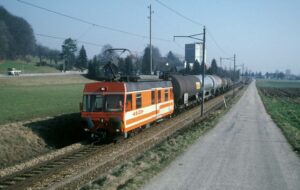
The neighbouring OJB formed an operating partnership with the SNB and used the vehicles freely on both lines. It was one of the few companies to procure a new vehicle solely for use in freight transport. This vehicle also hauled oil trains, among other things.
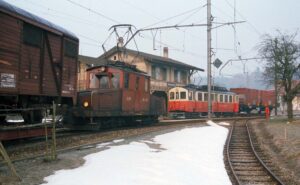
The OJB also operated a busy freight service on its own lines. Many carrier truck trains ran from the transhipment point in Langenthal to both Melchnau and Niederbipp. This meant that, in addition to the Ge 4/4 56 freight locomotive, several passenger railcars also had to be used.
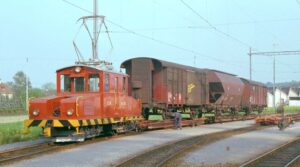
The truck transfer facility in Langenthal with the Ge 4/4 56 freight locomotive was a familiar sight for decades. Apart from the yellow and black warning bars, the locomotive is still largely in its original condition.
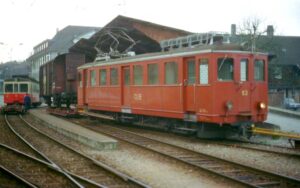
The powerful railcar no. 6 was soon used only for freight transport and exchanged its red and white livery for the brown paintwork used for service vehicles. It was rare for railcars of the 80 series to haul carrier trucks, as can be seen in the background of this picture.
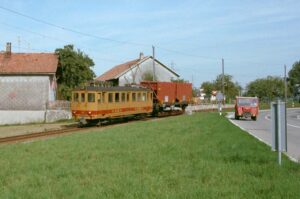
There was a huge increase in traffic when waste transport from Niederbipp to the Langenthal incineration plant was taken over. This was mostly the task of railcar no. 53, whose paintwork had meanwhile been changed to mustard yellow with a red bar.
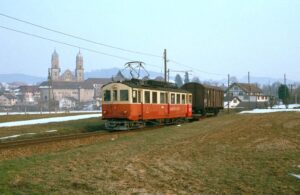
The SNB railcar no. 4 was frequently used for both freight and passenger transport. It was apparently well geared and popular with train drivers. Here it is underway near St. Urban Monastery.
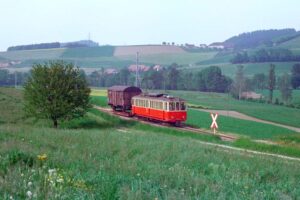
When there was an emergency, even the narrow-window railcar no. 1 was used. Here it is on its way just below Melchnau.
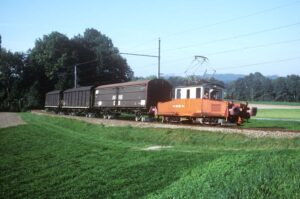
The OJB also switched to rollbocks later, as this picture shows. With its oversized standard gauge buffers and mounted headlamps, locomotive no. 56 did not become any prettier…
VBW Vereinigte Bern – Worb – Bahnen
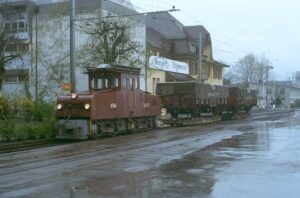
From the outset in 1907, the VBW operated unbraked carrier bogies with steam tram locomotives for the Wenger pasta factory in Gümligen. With electrification came the switch to braked carrier trucks, which enabled the development of Worb via the ramp route from Gümligen.
The Ge 4/4 61 and 62 freight locomotives were taken over from the Hagen tramway in 1961/1962 due to the sharp increase in freight traffic.
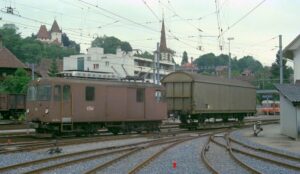
Carrier truck operations were also possible on the other line (in the Worblental valley) from Worblaufen, meaning that Worb was served from two sides. Initially, the De 4/4 no. 105 railcar was used for this purpose, but later the 101, 102 and 105 vehicles were also used freely.
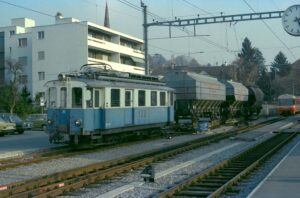
In Worb, the BDe 4/4 39 railcar was used as a shunting vehicle for a long time.
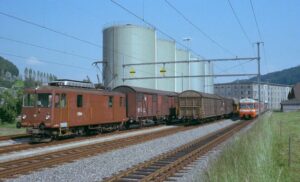
In the Worblental valley, the cardboard factory at Deisswil and the paper mill were very important customers, which were connected by a three-rail track.
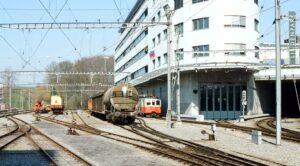
In Worblaufen, all three systems discussed today could be seen side by side: carrier trucks, rollbock operation and three-rail track.
SZB Solothurn – Zollikofen – Bern – Bahn
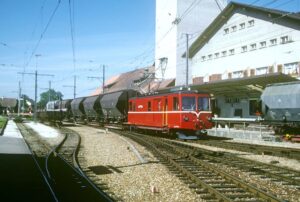
The neighbouring SZB also offered carrier truck operation from Solothurn, normally using the De 4/4 103, which had been converted to chopper technology.
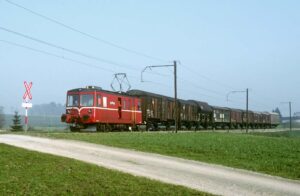
Later, Solothurn switched to transporter bogie operation, resulting in impressive trains.
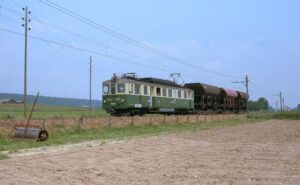
Only very rarely did passenger railcars have to be used for freight transport.
With the withdrawal of SBB from the area, freight transport on the SZB and VBW also declined.
BOB Berner Oberland-Bahn
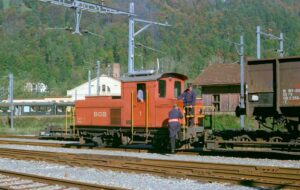
The BOB owned a Stadler battery tractor for transhipment in Interlaken, which was later converted to diesel operation.
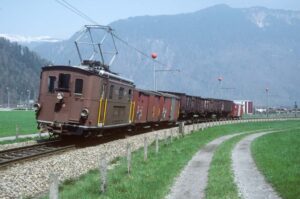
For a long time, HGe 3/3 locomotives from the electrification era were used for freight trains. Narrow-gauge freight trains ran as far as Grindelwald and Lauterbrunnen. However, the carrier trucks could not pass the rack sections, so they ended in Zweilütschinen at the latest.
… although that’s not 100% true. Anyone who has studied the railway history of 24 April 2024 closely will remember that trucks were also used to transfer locomotives to the Schynige Platte and vice versa on the rack section and as far as Lauterbrunnen.

In later years, when there were enough passenger railcars available beyond peak times, these took over the freight trains.
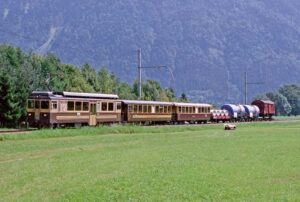
An impossible combination: the newest and most powerful passenger railcars with corrugated side walls being used for freight trains! First and foremost, two open platform passenger cars that were only used at absolute peak times (keyword: Lauberhorn ski race)…
SBB Brünigbahn
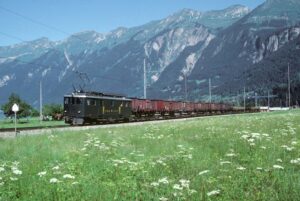
The neighbouring Brünig Railway used the same transhipment facility in Interlaken for the section to Meiringen and also had a considerable volume of freight to handle. There were timber transports, transports for the army, …
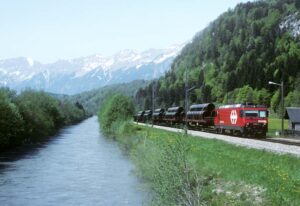
… and transports to Innertkirchen for the Grimsel power stations, among others. What is special is that the latest HGe 4/4 II locomotives were used to transport these pipes for a transalpine gas pipeline. We will encounter the pipes again…
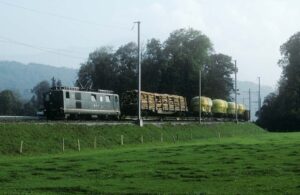
There was also some freight traffic on the Lucerne side of the Brünig Railway from Lucerne. For a long time, Deh 4/6 baggage railcars were also used as traction vehicles. To everyone’s surprise, after the delivery of the new HGe 4/4 II locomotives, the two HGe 4/4 I locomotives suddenly began to be used for freight trains on the flat sections on both sides of the Brünig pass.

The Gmeinder second-hand diesel locomotive Tm II 599 was purchased from Germany especially for freight transport.
MIB MIB Meiringen – Innertkirchen – Bahn der KWO
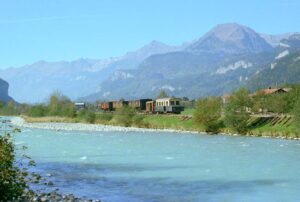
As already mentioned above, some freight continued from Meiringen to Innertkirchen. Originally, only the two low-performance battery railcars nos. 4 and 5 were available for these transports. From time to time, Aebi Tm II tractors from the Brünig Railway rushed to the rescue.
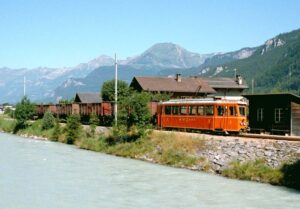
After electrification, two second-hand trams nos. 6 and 7 joined the MIB, which were capable of pulling surprisingly long trains. Sure, there aren’t too many gradients…
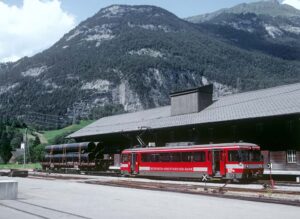
The Be 4/4 8, newly purchased from Stadler, also proved useful from time to time in freight train haulage, here upon arrival in Innertkirchen. We already know the pipes!
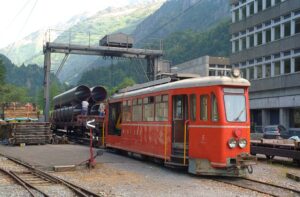
And anyone who thought that the old trams ended up as scrap after the arrival of railcar 8 will be proven wrong here. Converted to a Bem 4/4 with a diesel engine (although the e should be removed due to the lack of a pantograph, and there are no longer many B, i.e. passenger seats…) and an open side wall for the compressor, vehicle no. 6 continues to be indispensable.
LSE Luzern – Stans – Engelberg – Bahn
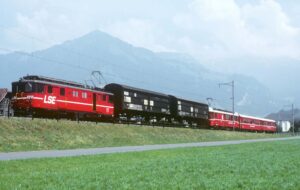
What the Brünig Railway can do, the LSE can do too… At least as far as Grafenort, where the rack section begins. However, freight trains usually ended at Stans. Why this rather unusual combination of freight train and passenger train came about is not known. Was it to save route allocation costs, or were separate routings simply not available on the single-track line?
WSB Wynental- und Suhrentalbahn
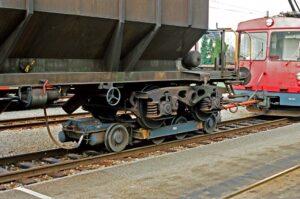
Let’s swing back to the Mittelland, where the WSB started operating unbraked bogies as early as 1901. These were supplemented with air brakes in the 1920s and remained in service until 2000. Among other things, there was also a proprietary conversion of transporter bogies for 4-axle freight wagons.

Rollbock operation took place from the transhipment point in Suhr to the end of the line in Menzingen, where the old Be 4/4 15 served as a shunting vehicle for a long time. Chains were sometimes used to serve the aluminium factory. The national accident prevention authority would go berserk nowadays!
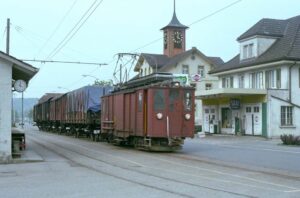
For a long time, the aging De 4/4 41, 42 and 49 freight railcars with wooden bodies were in service and handled all freight traffic.
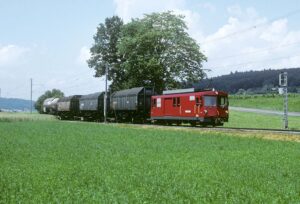
WSB was one of the few railways to purchase three new vehicles specifically for freight transport. The De 4/4 were built by Siemens in 1974 together with a few passenger railcars and were equipped with what was then state-of-the-art stepless chopper control.

However, as there were still not always enough vehicles available for freight transport, the first modern Be 4/4 no. 6 passenger railcar was converted for freight use.
Time flew by and the rest of the presentation had to be saved for a second part. We hope that everyone who enjoyed the exciting first part of the presentation will be our guests again for the second part.
This also gives everyone who was unable to attend, or who has been intrigued after reading this heavily abridged report, the opportunity to experience part of it after all. See you soon!
Back to: