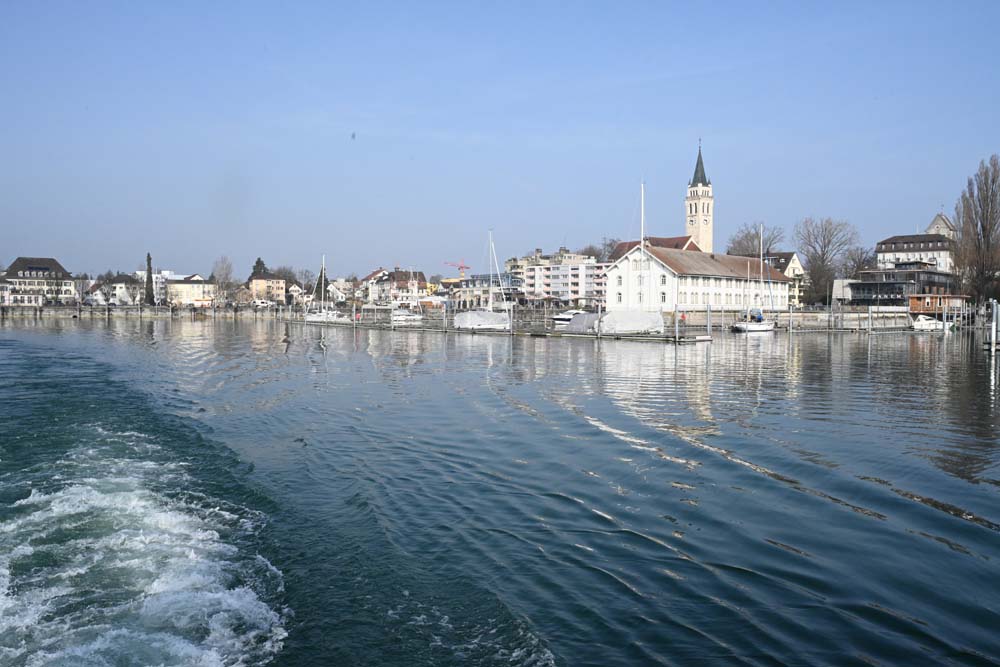
 This year, participants of our AGM with accompanying programme met at Romanshorn, where the motor vessel ‘St. Gallen’ was waiting. It served as a replacement for a car ferry that is currently undergoing maintenance.
The photo shows a historic warehouse in front of the church at the entrance to Romanshorn harbour. 7 March 2026 Photo: © Edi Meier, Bülach
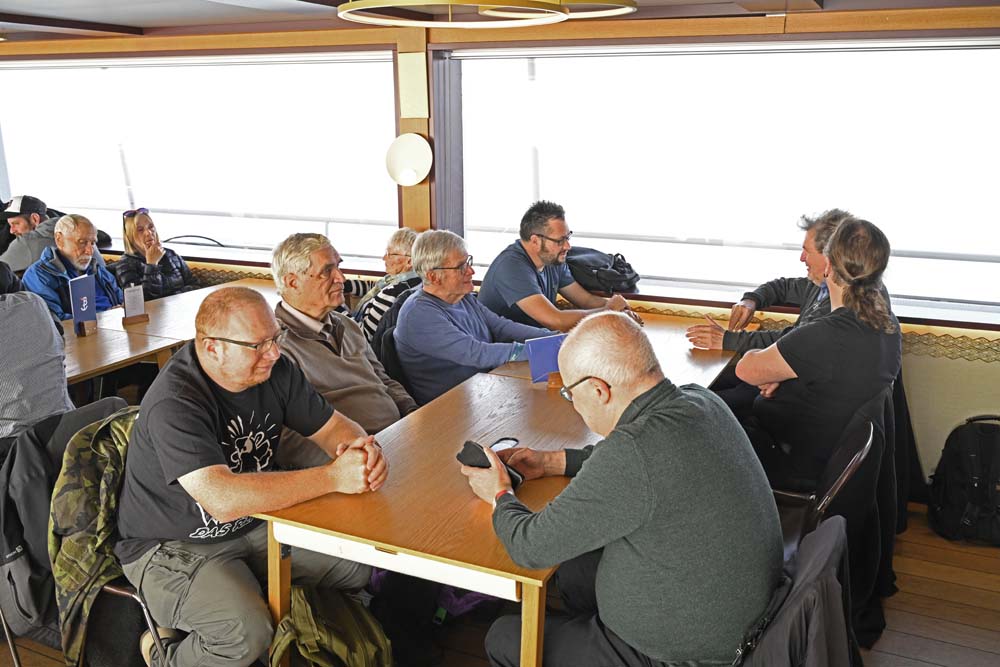 Thanks to our advance booking, we were able to meet at two tables for initial discussions and strengthen ourselves with coffee and croissants. 7 March 2026 Photo: © Edi Meier, Bülach
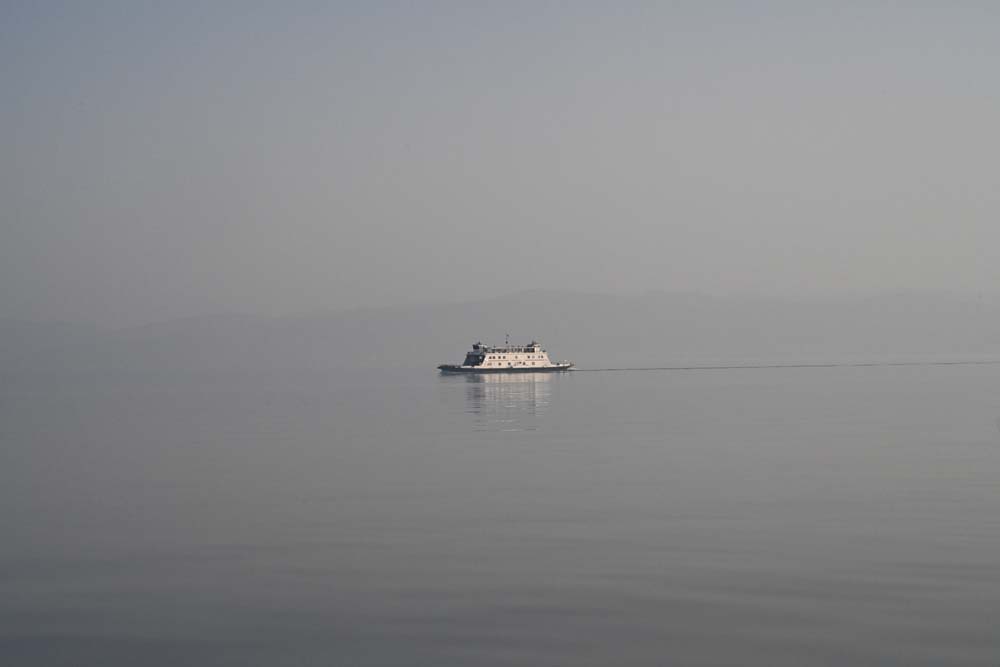 With sunny weather and a «calm sea», the crossing was very pleasant. However, due to Saharan dust in the air, it was very hazy, so that one could no longer see the mountains or the shore from the middle of the lake. 7 March 2026 Photo: © Edi Meier, Bülach
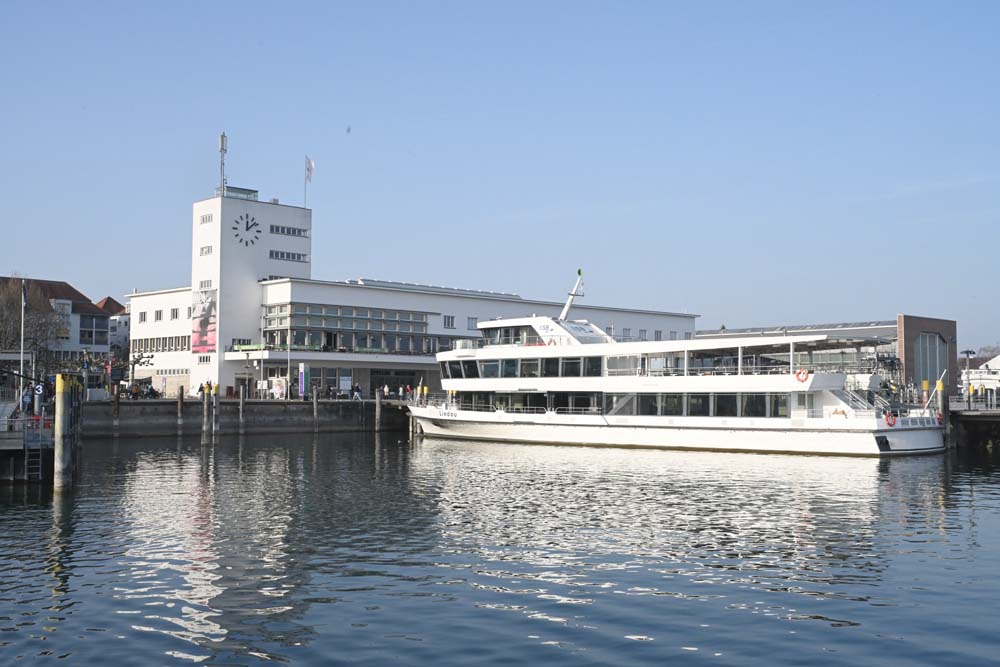 The Zeppelin Museum is located in the former operations building of Friedrichshafen’s harbour station (the striking building in the centre of the picture), which was rebuilt true to the original after having been destroyed during the war. 7 March 2026 Photo: © Edi Meier, Bülach
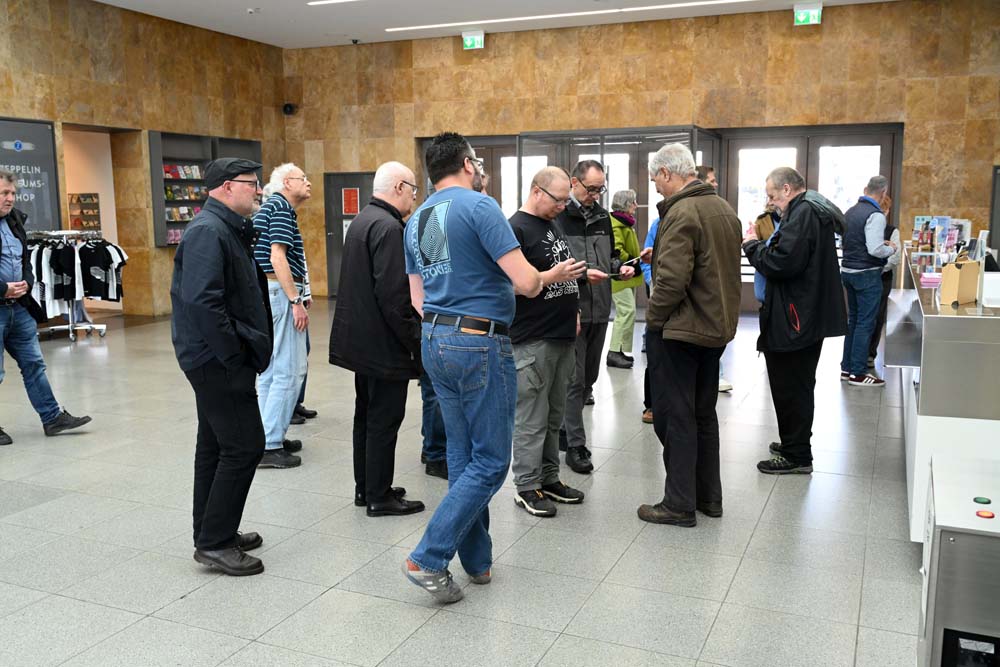 We were able to store our luggage in lockers and, after the tickets had been handed out, Sarah Kirchner introduced herself as our guide. 7 March 2026 Photo: © Edi Meier, Bülach
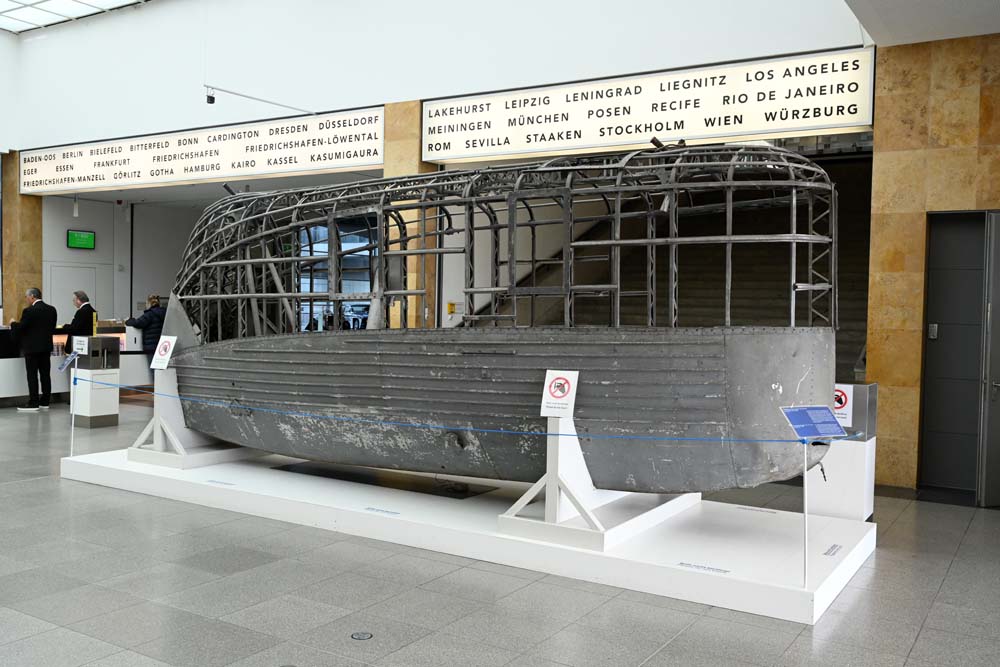 Opened in 1996, the Zeppelin Museum in Friedrichshafen houses the largest collection of original Zeppelin artefacts and provides in-depth information on the technology and operation of these airships. An engine nacelle stands in the entrance hall. 7 March 2026 Photo: © Edi Meier, Bülach
The centrepiece is the Zeppelin LZ 129 ‘Hindenburg’, built between 1930 and 1936, which remains unforgettable due to the accident during its attempted landing at Lakehurst on 6 May 1937, which was extensively documented in the media. The highlight is undoubtedly the replica of a small section of the Hindenburg’s hull, constructed according to original plans and partly using original tools.
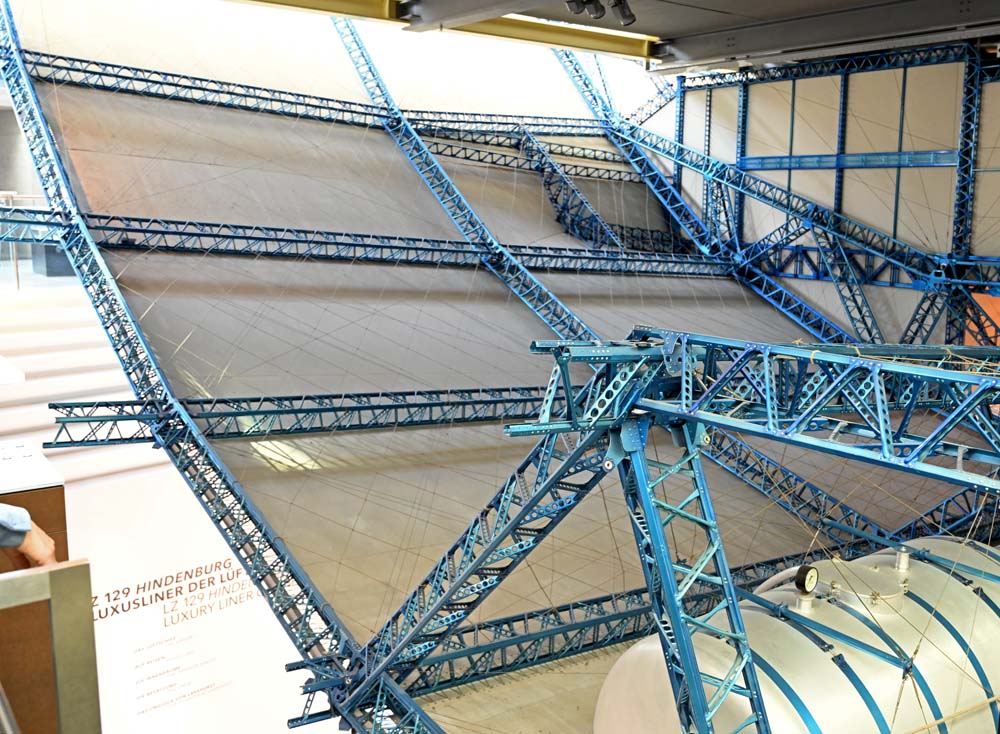 Rigid-frame airships, which include Zeppelins, are essentially a further development of gas balloons. Like balloons, Zeppelins use gases lighter than air (helium, or hydrogen if necessary) for lift. Unlike balloons with a flexible shell, Zeppelins have a rigid outer shape thanks to a metal framework (shown in blue in the photo). The metal framework, made of folded aluminium sheets, was an extremely lightweight construction and, despite its enormous dimensions, appears incredibly delicate. 7 March 2026 Photo: © Edi Meier, Bülach
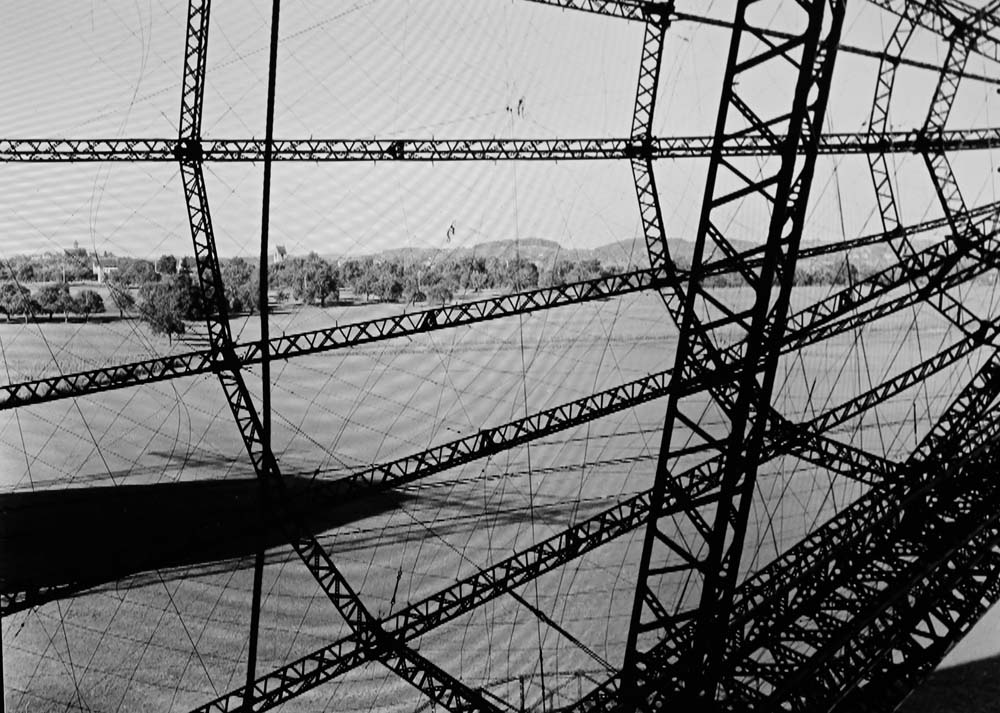 body formed at regular intervals with circular struts and longitudinal braces. Photo: Zeppelin Museum, Friedrichshafen (Reproduction: Edi Meier, Bülach)
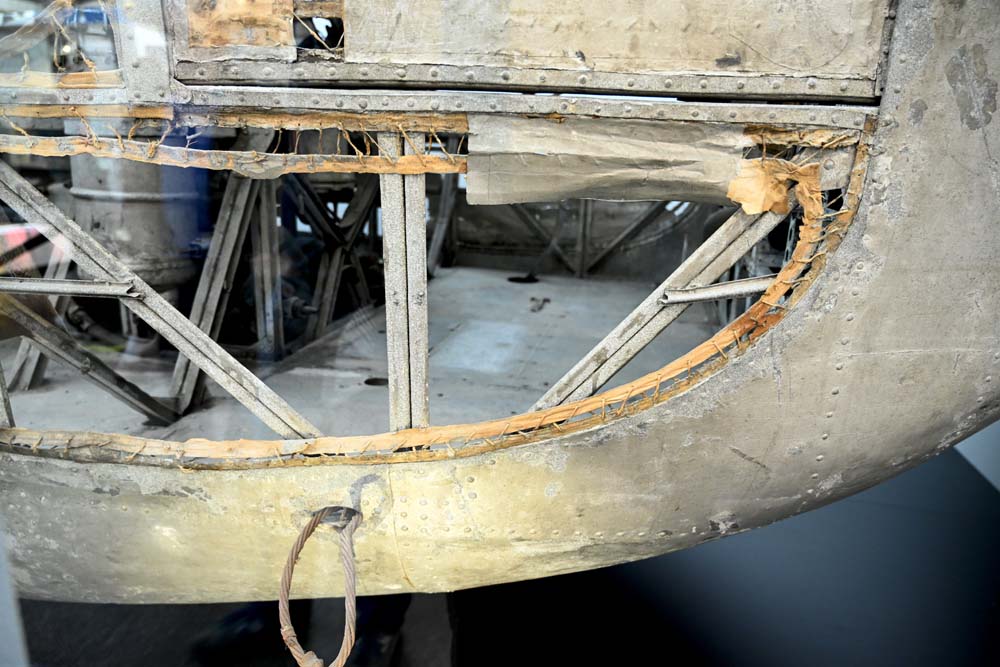 On the outside, the framework was covered with several layers of cotton cloth, which was sealed with cellulose lacquer. Aluminium powder was mixed into the outermost layer of lacquer to provide thermal insulation and for visual effect. 7 March 2026 Photo: © Edi Meier, Bülach
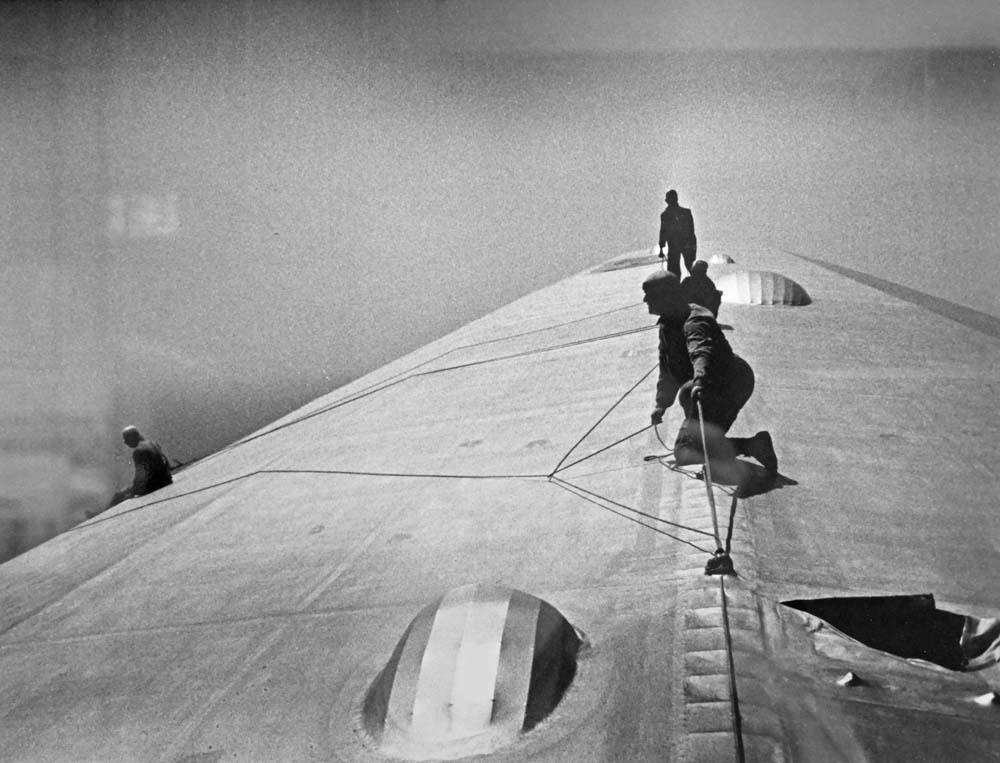 Gas-filled bags made from multi-layered sewn-together bovine intestines were installed between the frames (around 700,000 per Zeppelin), providing the lift. Below and between these bags, narrow passageways were left free for the crew to access the propulsion engines and as spaces for repairs (gas leaks!), which were also carried out in flight, even on top of the outer skin! Photo: Zeppelin Museum, Friedrichshafen (Repro: Edi Meier, Bülach)
Supply tanks were also installed in the lower section, and there was space available for payload.
There were several attempts to build such airships, but they failed due to weight or other difficulties. The development efforts were initially driven primarily by military motives. The airships were intended to be used for reconnaissance over enemy territory and for dropping bombs. With the advent of smaller and more manoeuvrable aeroplanes, the Zeppelins became easy targets and their military utility remained a fleeting memory, falling well short of expectations.
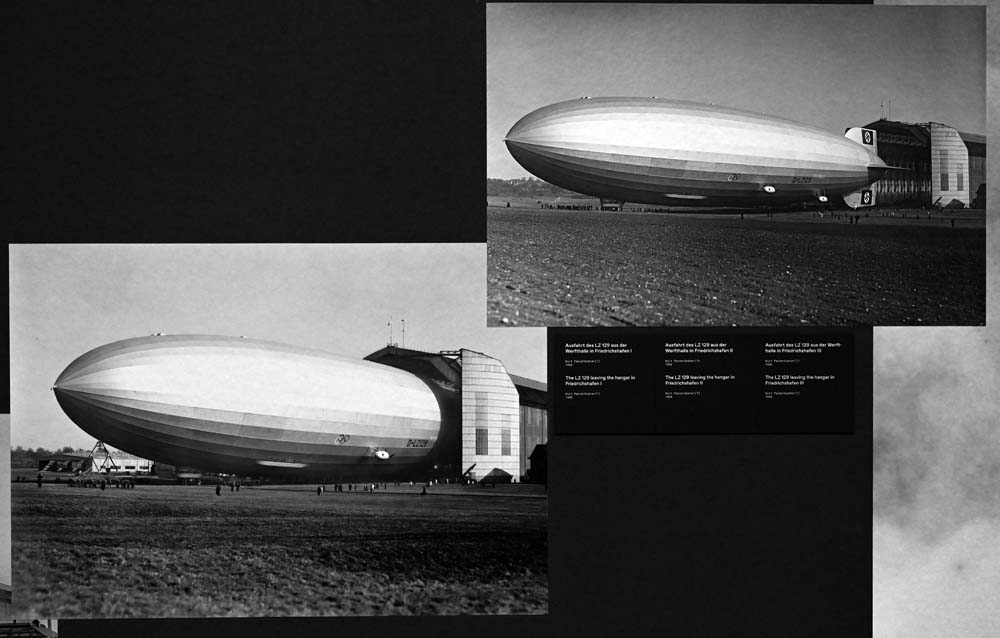 Count Zeppelin, who began building airships in a wooden hangar in Friedrichshafen around 1900, also initially pursued military objectives. When, after dozens of failures and several years of development, he finally had a serviceable version, he had to look for other areas of application and switched to commercial use carrying passengers. Photo: Zeppelin Museum, Friedrichshafen (Reproduction: Edi Meier, Bülach)
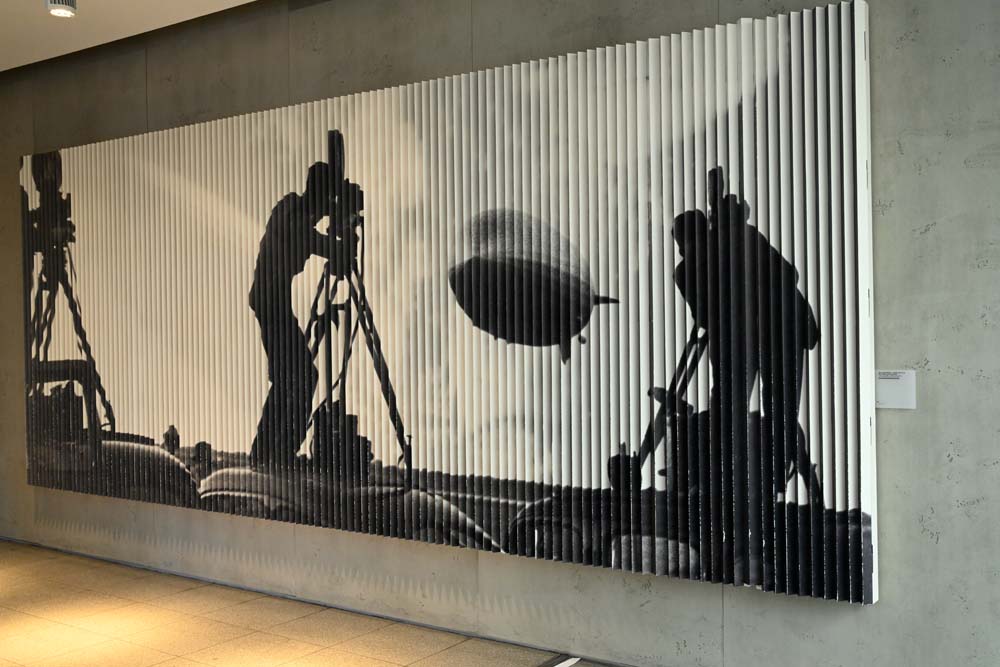 Right at the entrance to the museum, slanted metal panels display a historical photograph of the Hindenburg on its approach to Lakehurst. Zeppelin landings were rare, which is why there were always many onlookers and photographers on site; they would then act as helpers, clinging to the lowered ropes until the airship was securely moored to the landing mast. This is how the famous photographs were taken. Photo: Zeppelin Museum, Friedrichshafen (Reproduction: Edi Meier, Bülach)
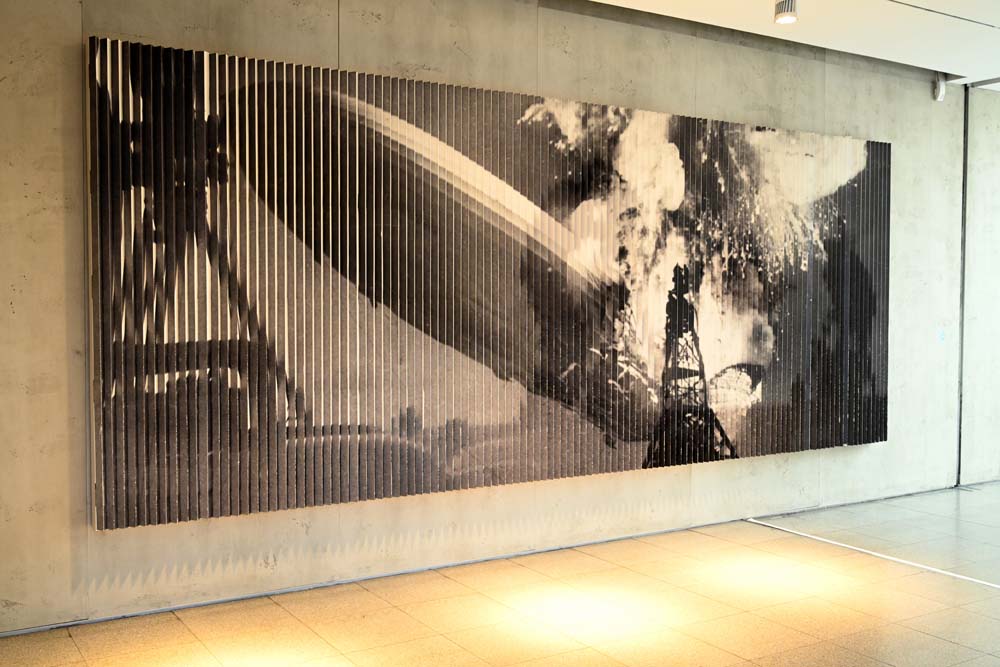 As the camera pans further, the image shifts to the famous shot of the huge fireball. For military reasons, the sole manufacturer, the USA, refused to supply non-flammable helium, which is why the Hindenburg’s gas bladders were filled with highly flammable hydrogen. Incidentally, 36 people survived the spectacular disaster. Photo: Zeppelin Museum, Friedrichshafen (Reproduction: Edi Meier, Bülach)
Straight ahead in the hall are a few vintage cars, which we didn’t look at in great detail, but which are connected to the Zeppelins. For example, cars by Maybach and others fitted with engines from this manufacturer are on display. Maybach engines, specially designed to minimise weight, were used in Zeppelins.
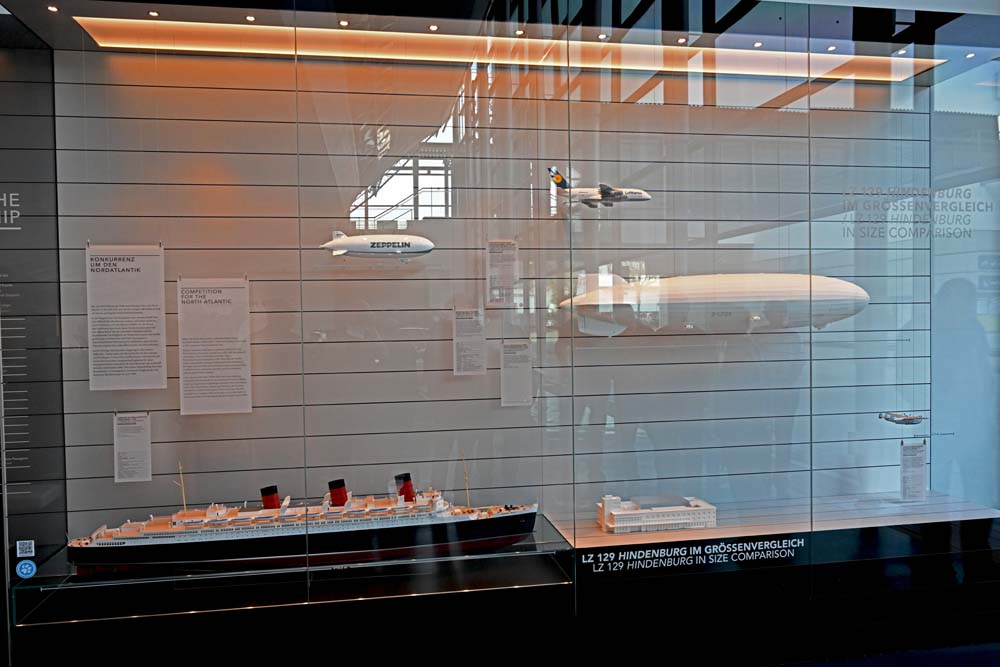 In a display case, scale models give an idea of the Hindenburg’s incredible dimensions compared to the Airbus A 380 (the world’s largest passenger aircraft, which flies directly above the Hindenburg looking like a dwarf) or the ocean liner Queen Mary. 7 March 2026 Photo: © Edi Meier, Bülach
In a display case, scale models give an idea of the Hindenburg’s incredible dimensions compared to the Airbus A 380 (the world’s largest passenger aircraft, which flies directly above the Hindenburg looking like a dwarf) or the ocean liner Queen Mary. 7 March 2026 Photo: © Edi Meier, Bülach
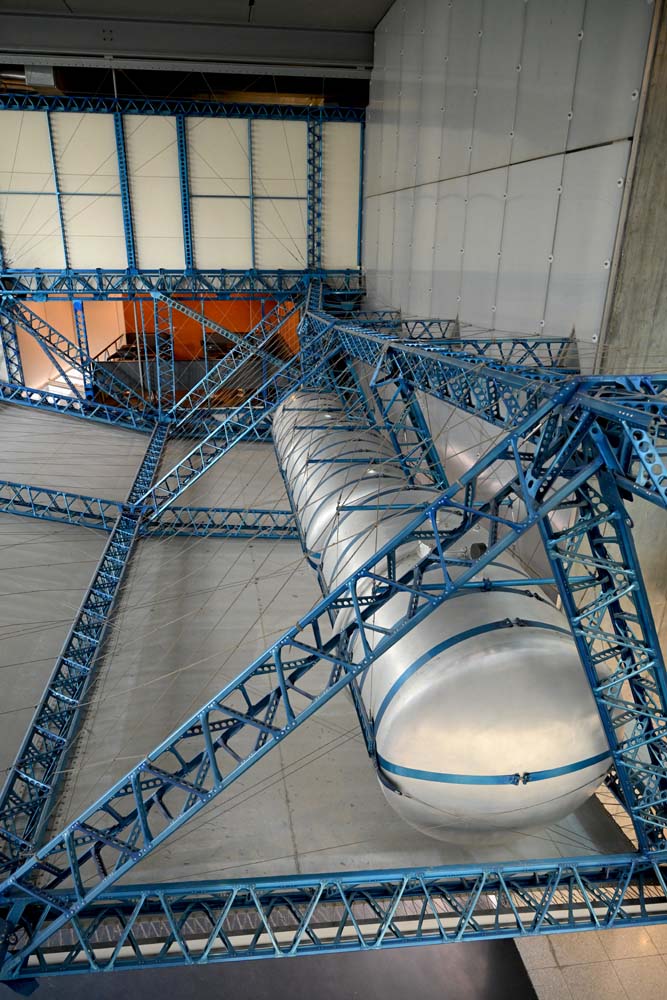 The lower section of the Zeppelin housed supply tanks (fresh water, waste water, gas, fuel) and the two-storey passenger area. Around 50 crew members were on board for three-shift operation, including passenger service. 7 March 2026 Photo: © Edi Meier, Bülach
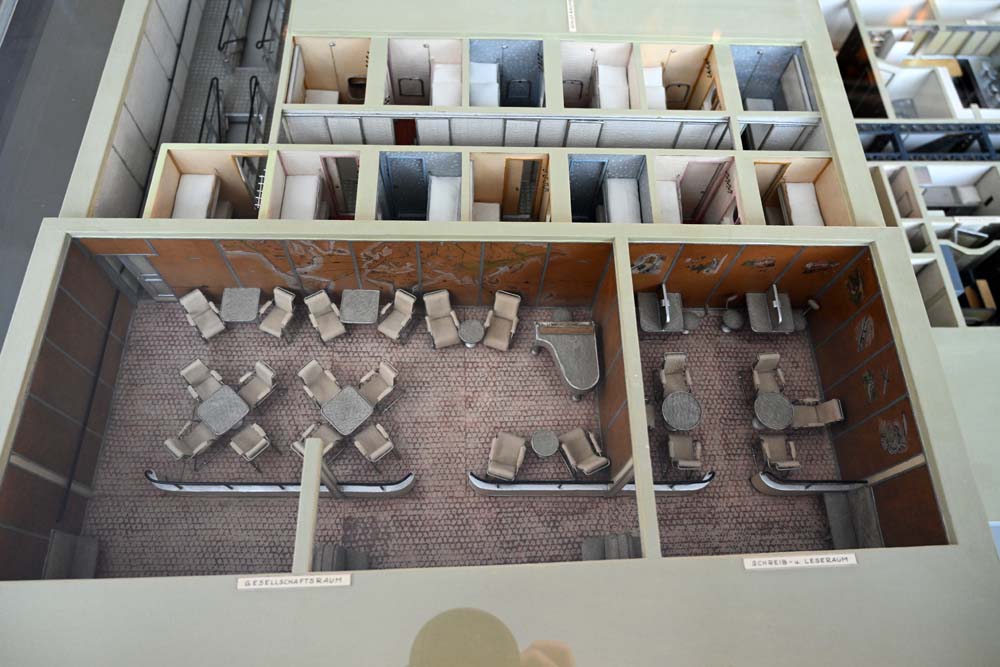 In a display case, Sarah used a model to draw our attention to the various rooms in the two-storey passenger area, which were fitted out in the lower, forward section of the Hindenburg. Journeys lasting several days make it easy to understand why there were many sleeping berths with two beds stacked one above the other for the initial 50, and later 72, passengers (the upper bed could be folded up, whilst the lower one could be used as a seat during the day). 7 March 2026 Photo: © Edi Meier, Bülach
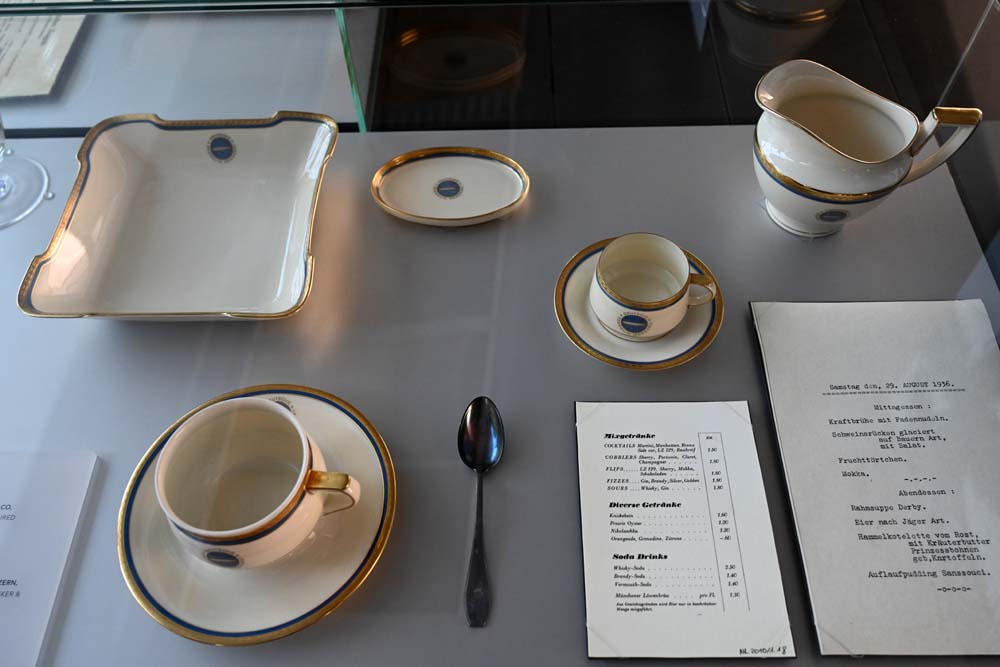 Showers with hot and cold water, as well as a lounge with floor-to-ceiling windows, a dining room, and a writing and reading room (complete with a post office featuring its own postmark) made the journey pleasant. In the dining room, the kitchen crew served freshly prepared, exclusive multi-course meals on special ceramic tableware. Initially, there was even an aluminium piano on board! 7 March 2026 Photo: © Edi Meier, Bülach
And, surprisingly, there was also a smoking lounge, although strict rules applied. Smoking products had to be purchased on board. Lighters were not permitted and only one crew member was allowed to light the cigars. The ashtrays had a water reservoir.
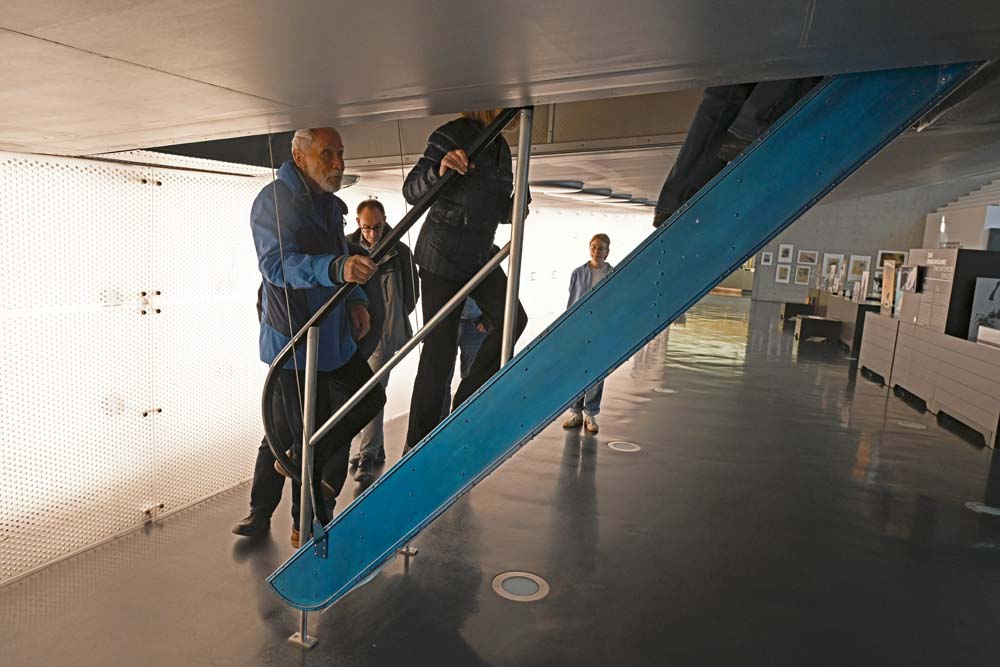 We then ascended a replica boarding staircase up into the interior of the reconstructed passenger cabin. 7 March 2026 Photo: © Edi Meier, Bülach
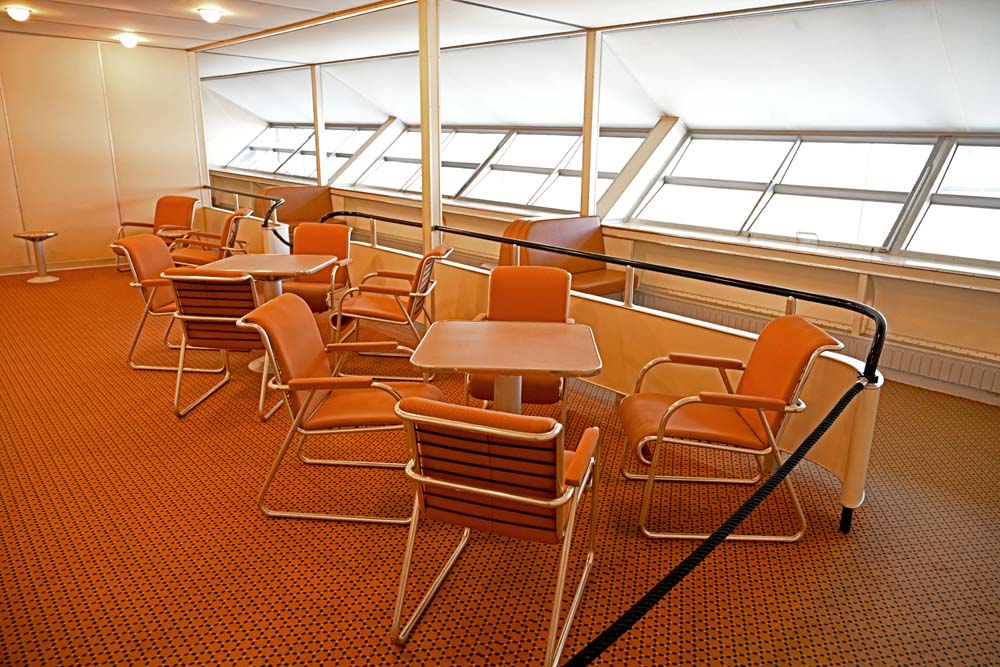 The replica saloon, featuring electric lighting, was designed in the Bauhaus style, which was modern at the time and also helped to save weight. You could sit on a viewing bench at the edge and look out through the large, sloping windows (which could be opened) and let the landscape pass by in your mind (or, in the past, in reality). 7 March 2026 Photo: © Edi Meier, Bülach
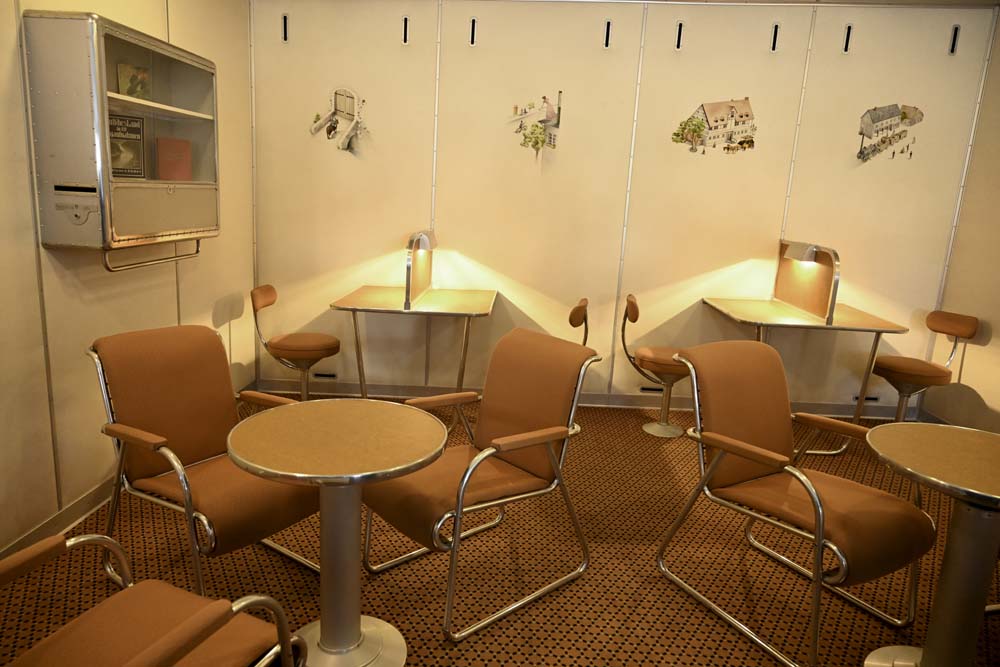 with a post office (the box on the left). Although letters were stamped on board, for local postage rates one had to rely on helpers on the ground. One would toss out the letters with a generous coin attached and a request that the finders use the money to post the letters at the nearest post office and keep the change as a reward for their trouble. 7 March 2026 Photo: © Edi Meier, Bülach
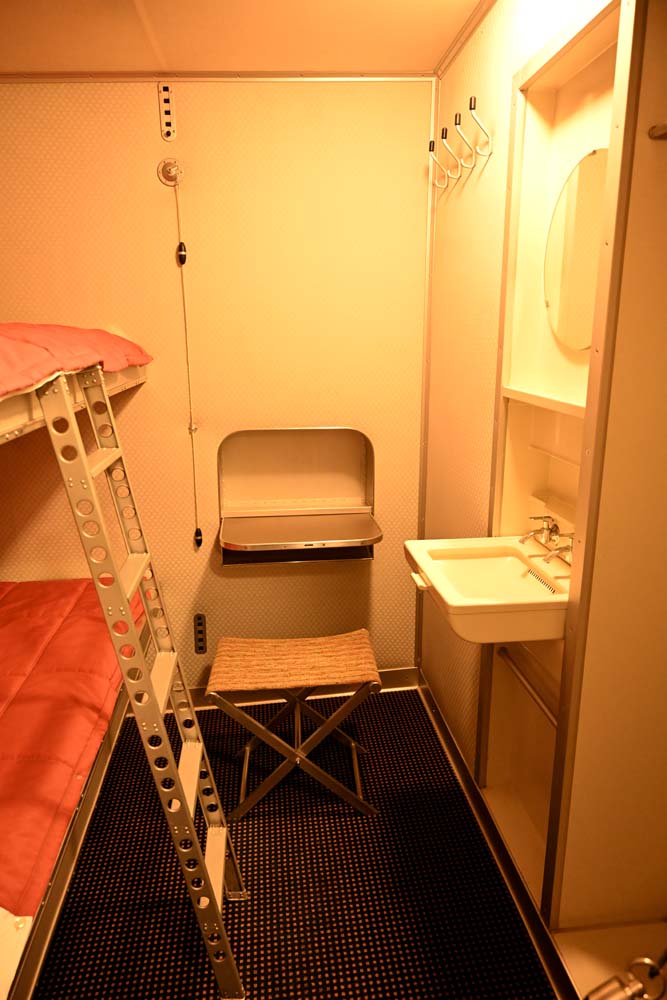 Right next door, one could visit the double cabins for passengers, all with running hot and cold water! Given this level of comfort, it is no wonder that such a journey cost 1,000 Reichsmarks, which was equivalent to six months’ wages for a skilled worker, such as an engine driver! 7 March 2026 Photo: © Edi Meier, Bülach
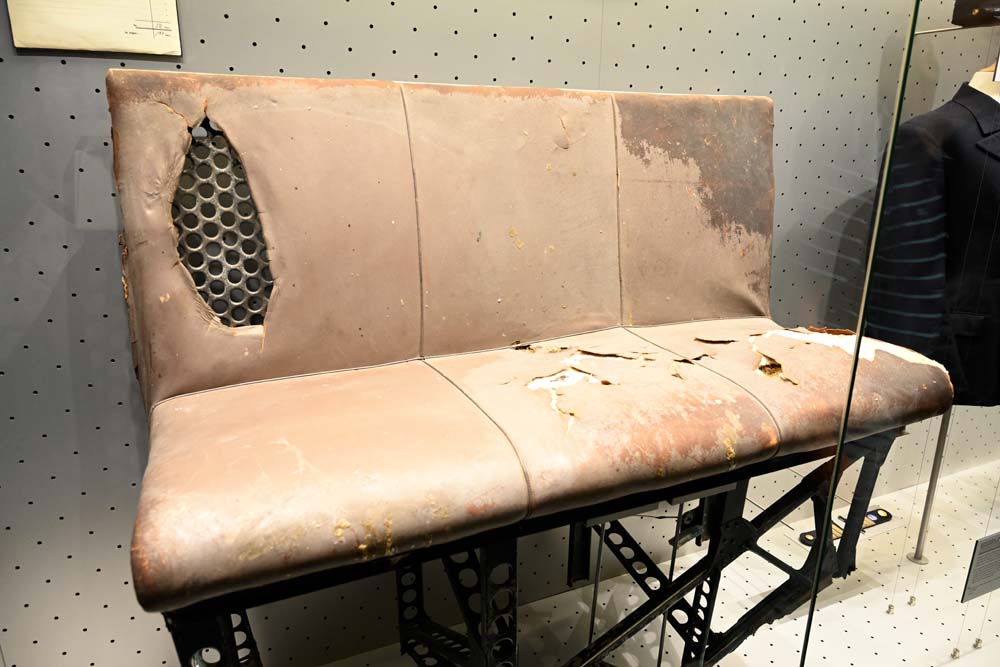 To round off the visit, another hall features large display cases containing numerous models and original parts from Zeppelins and other airships, which, together with historical photographs, brought the entire history to life once again. Here is an original bench. Naturally, to reduce weight, it has a perforated aluminium frame… 7 March 2026 Photo: © Edi Meier, Bülach
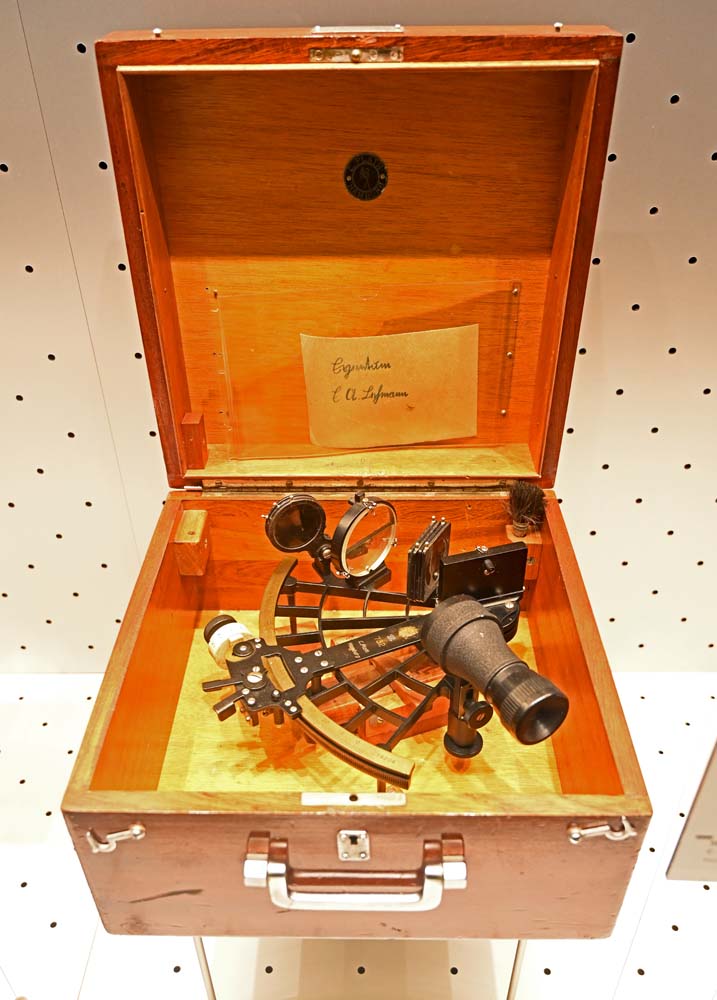 Navigation instrument (for determining position). 7 March 2026 Photo: © Edi Meier, Bülach
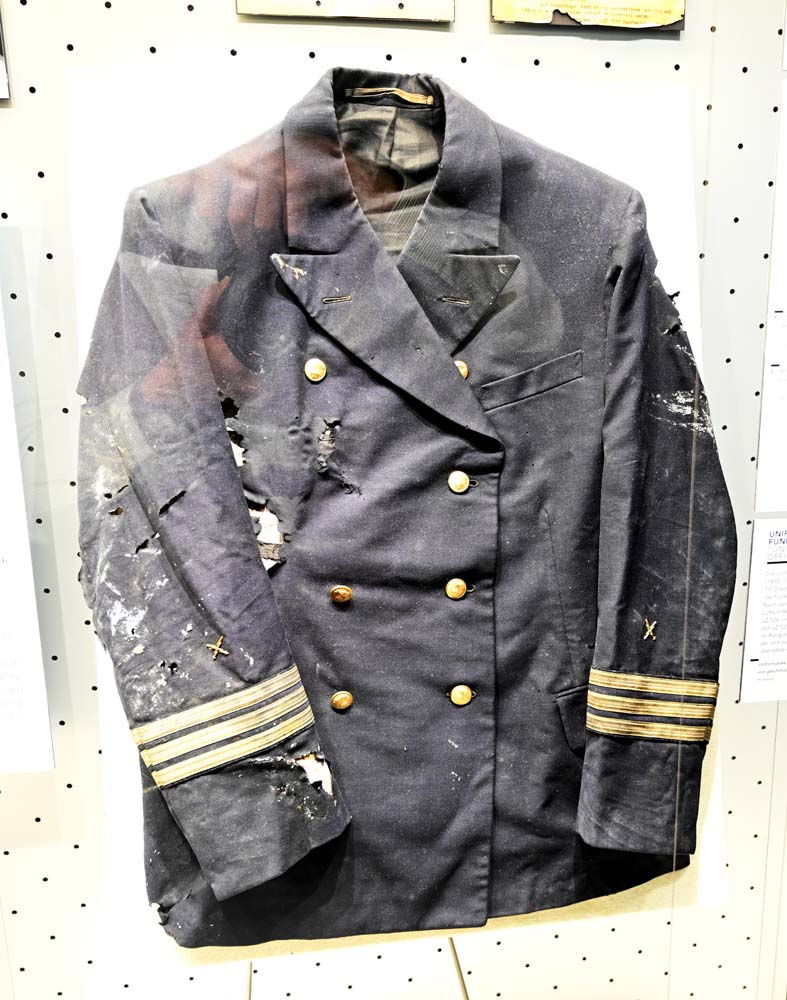 An original uniform has suffered some wear and tear, but still bears witness to its former splendour, as well as to the militaristic times. 7 March 2026 Photo: © Edi Meier, Bülach
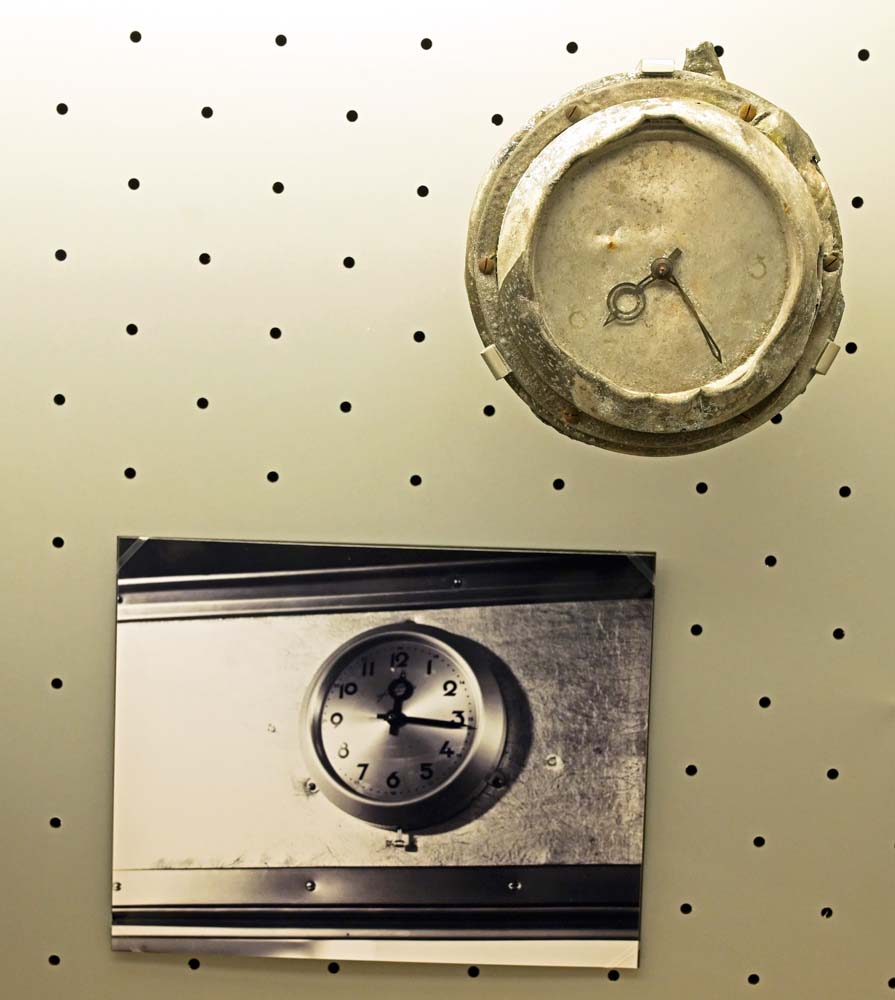 Clock from the Hindenburg before (photo) and after the catastrophic fire… It became so hot in the fireball that aluminium melted… 7 March 2026 Photo: © Edi Meier, Bülach
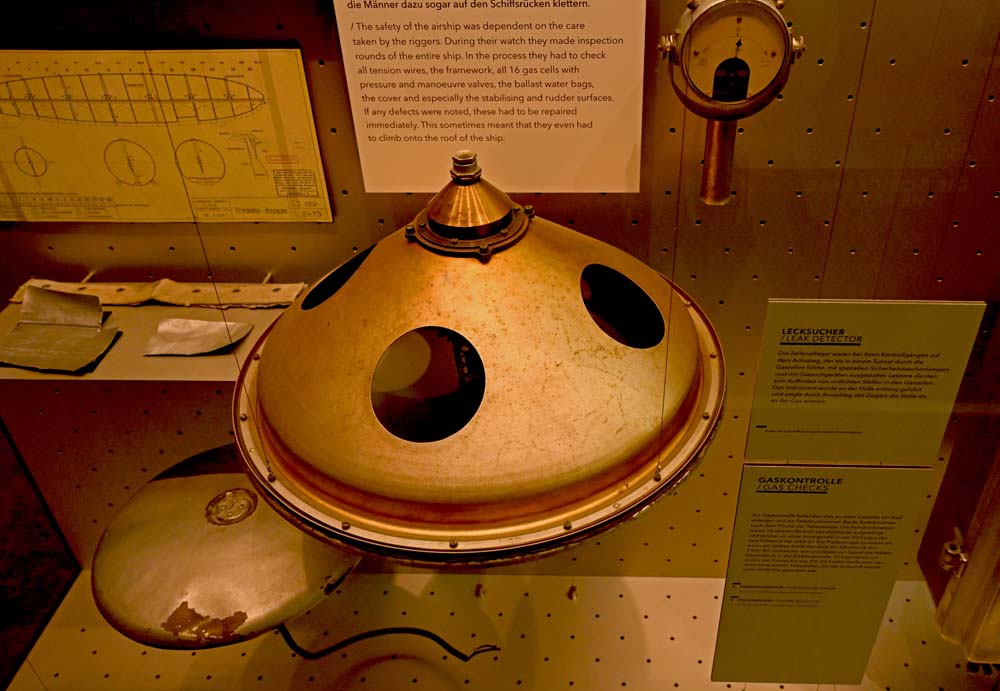 An elegantly designed gas leak detector 7 March 2026 Photo: © Edi Meier, Bülach
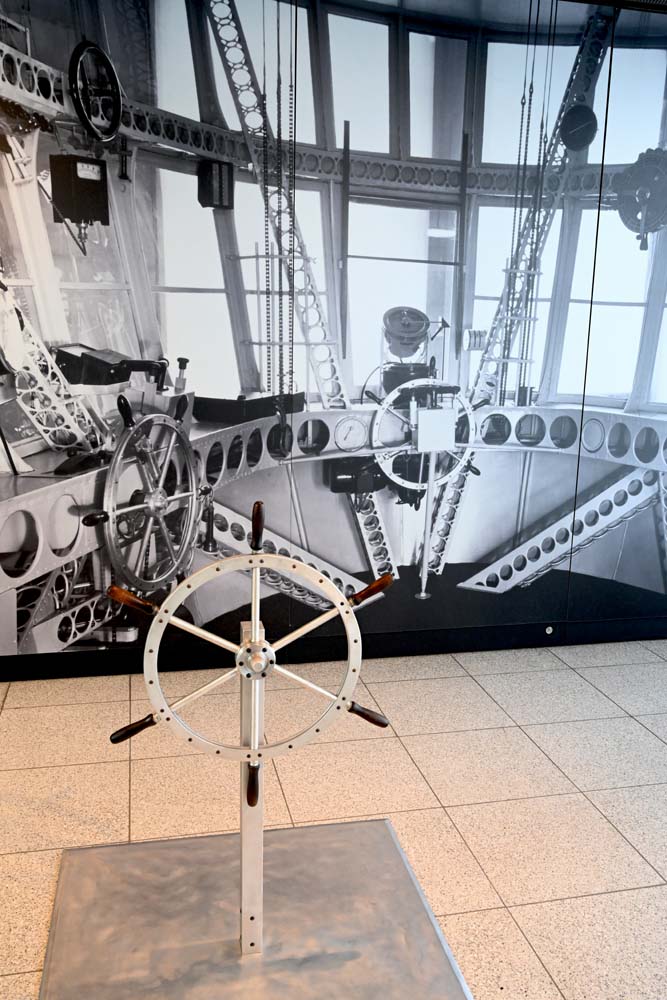 A realistic display of an original steering wheel in front of a large-format photograph of the control console. 7 March 2026 Photo: © Edi Meier, Bülach
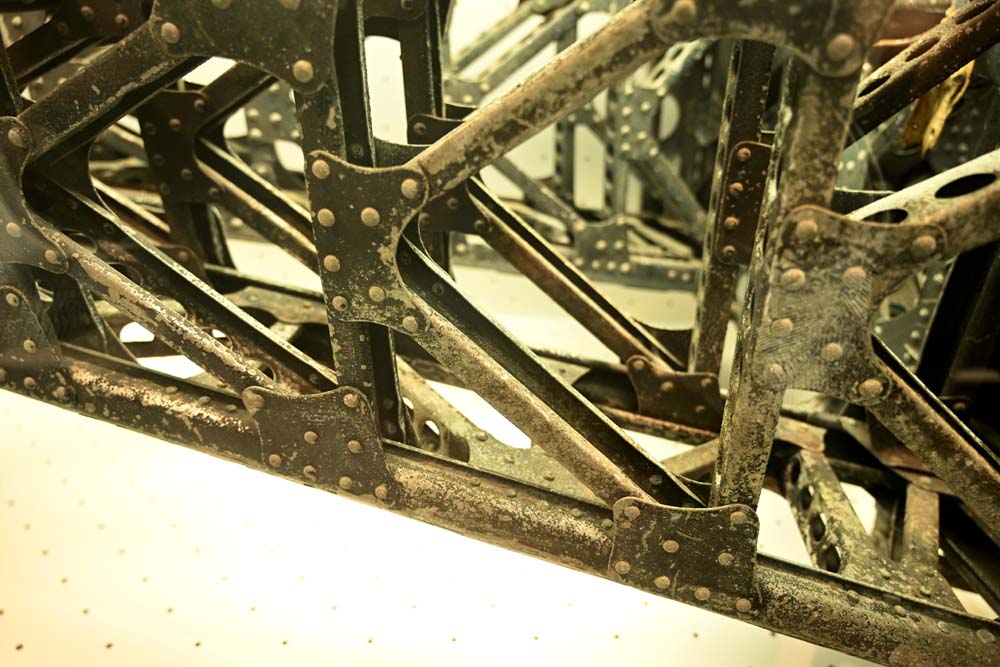 Detail of the delicate construction made from folded and riveted aluminium profiles. 7 March 2026 Photo: © Edi Meier, Bülach
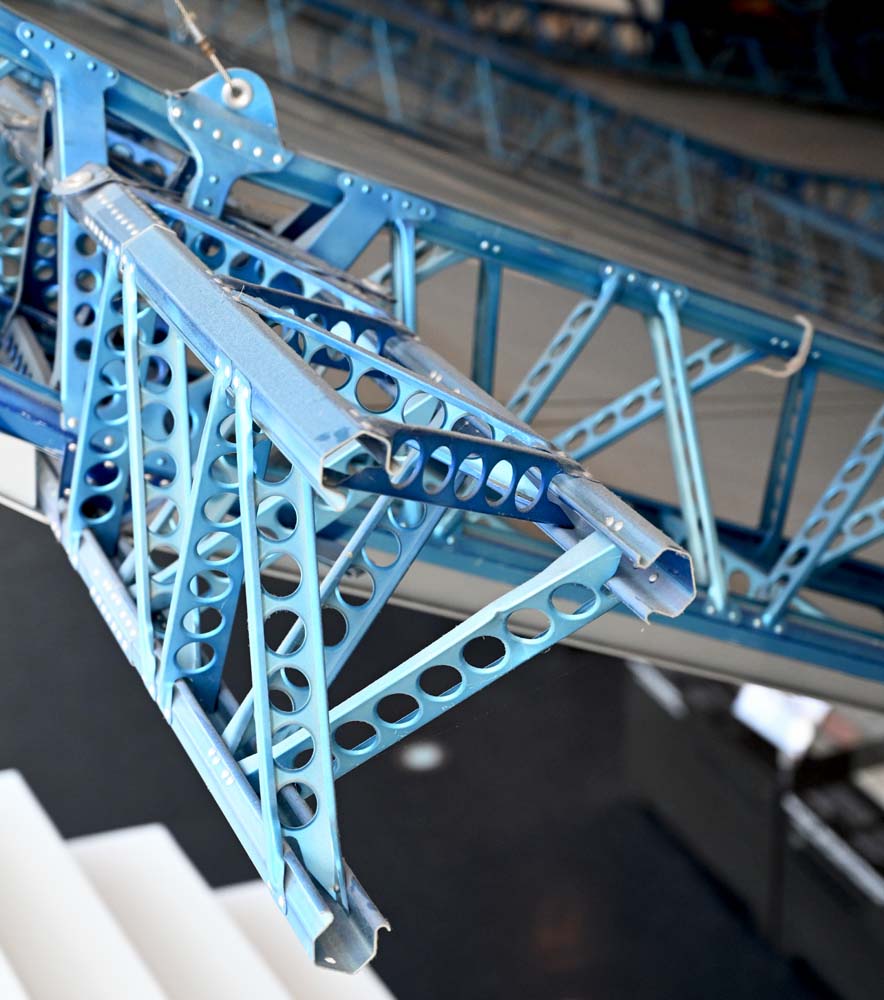 Such thin aluminium profiles were assembled into huge structures. 7 March 2026 Photo: © Edi Meier, Bülach
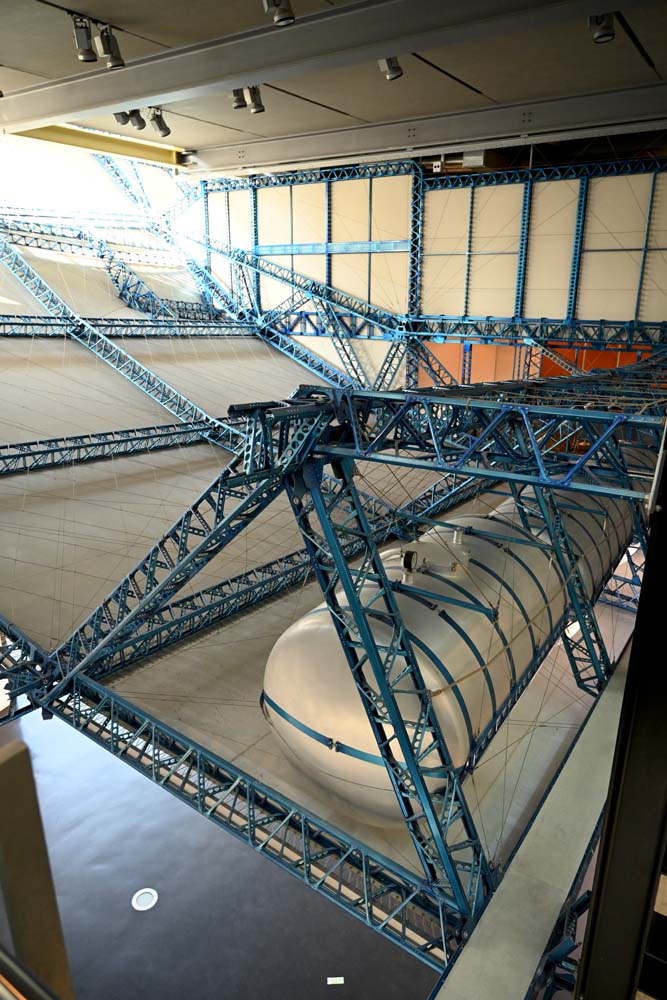 These breathtakingly large structures were then built using such fine profiles to support the shell… 7 March 2026 Photo: © Edi Meier, Bülach
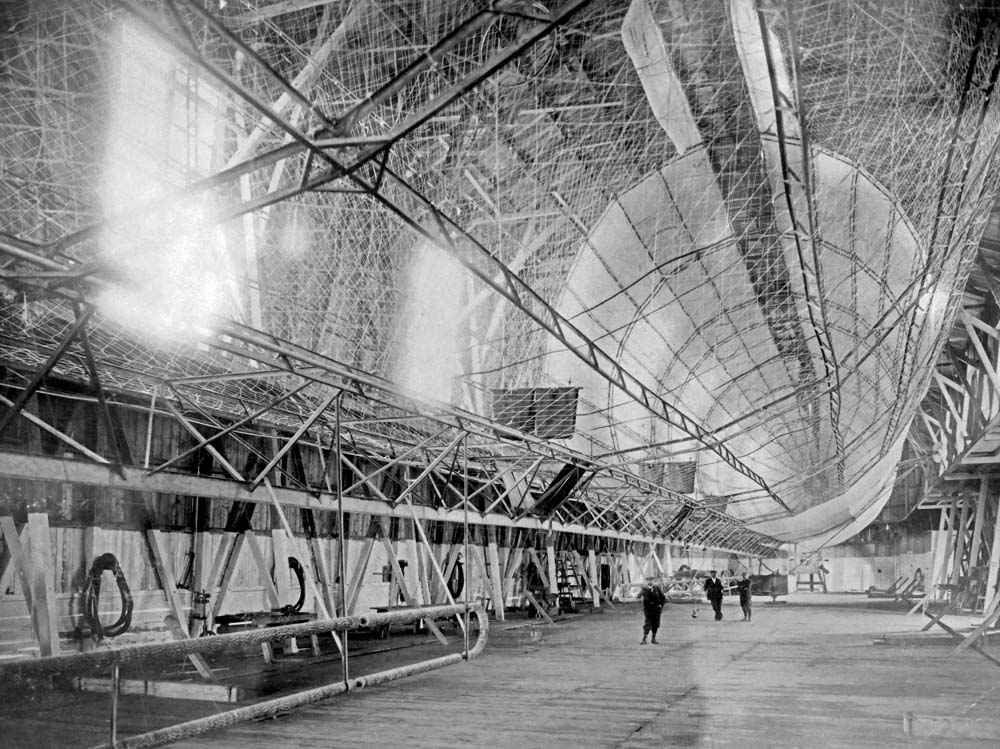 Just how stable – or rather unstable – the whole structure was in practice can be seen in this historical photograph… The longitudinal struts aren’t exactly straight… Photo: Zeppelin Museum, Friedrichshafen (Reproduction: Edi Meier, Bülach)
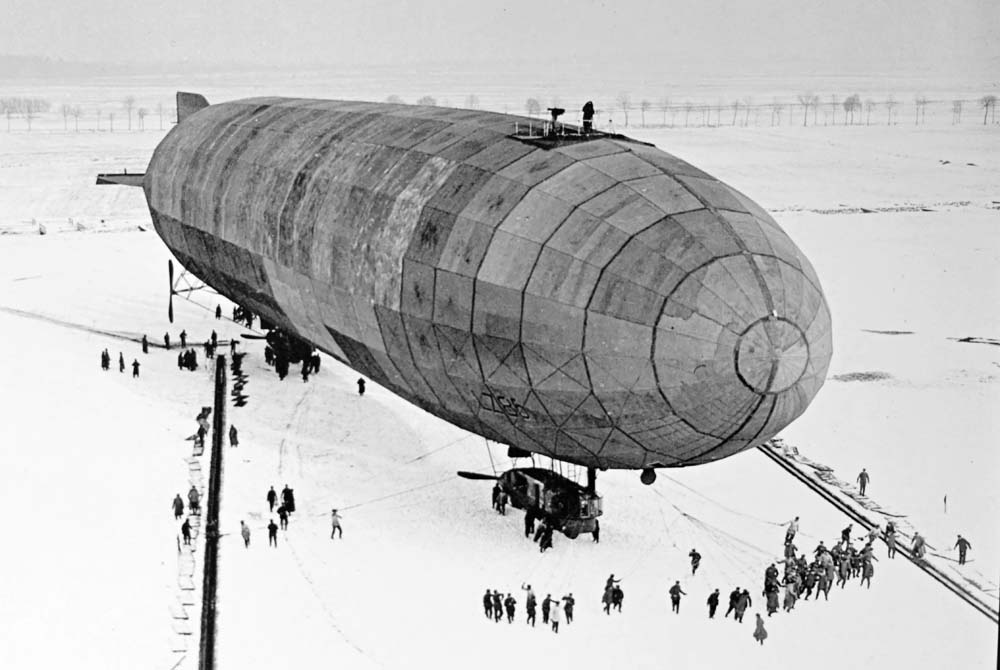 In another historical photo, one can get a sense of the incredible dimensions of these airships when compared to people… Photo: Zeppelin Museum, Friedrichshafen (Reproduction: Edi Meier, Bülach)
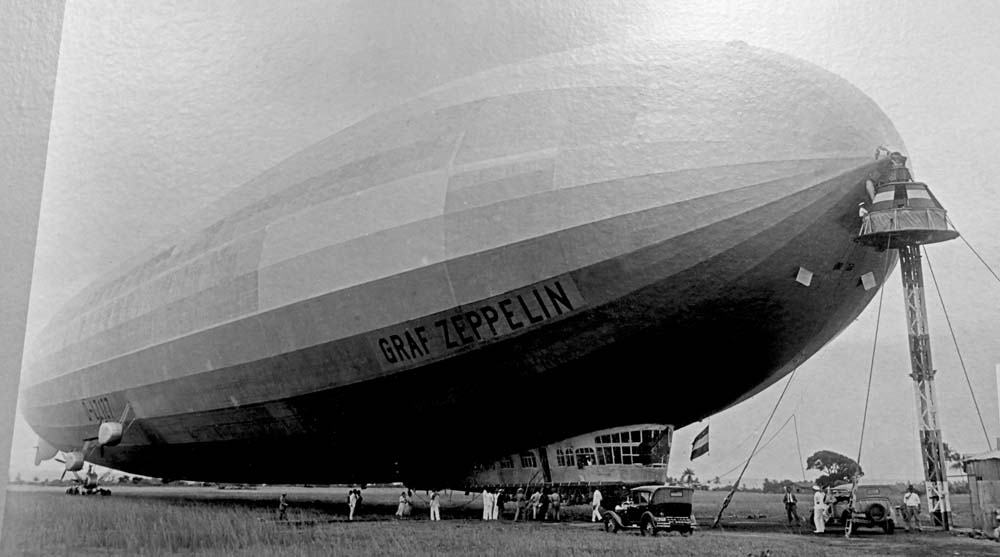 A Zeppelin (LZ 127 ‘Graf Zeppelin’) has docked at the landing mast following a successful landing. Just above the ground, the pilot’s cockpit is visible. This Zeppelin, the sister ship of the Hindenburg, also once circumnavigated the globe. Photo: Zeppelin Museum, Friedrichshafen (Reproduction: Edi Meier, Bülach)
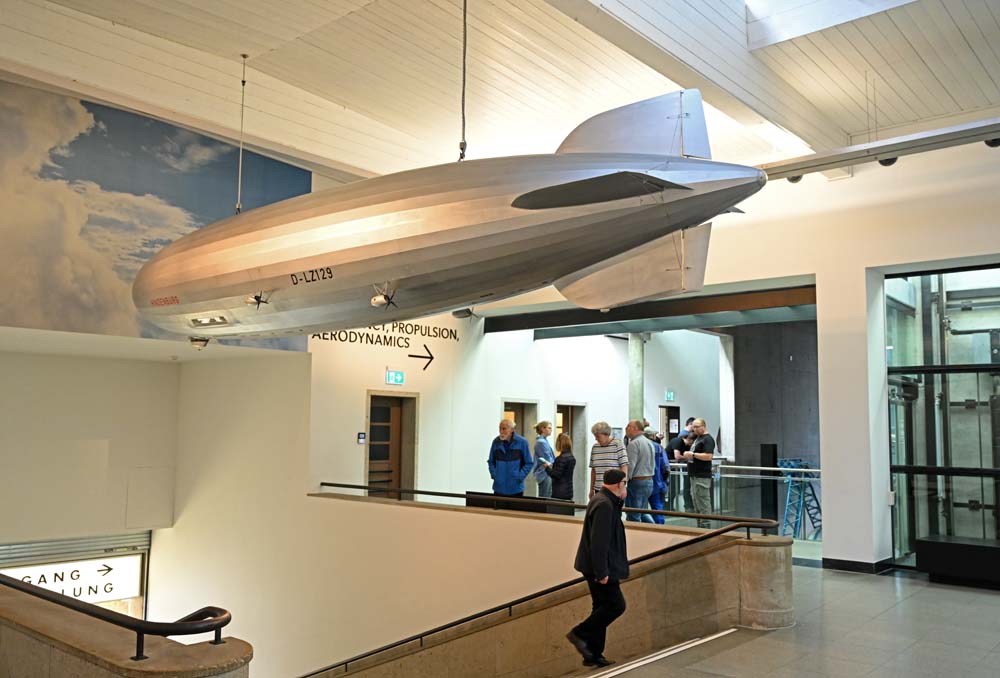 With that, Sarah took her leave (many thanks!) after a very exciting and informative 90 minutes, and we were able to strengthen ourselves with a hearty lunch in the museum restaurant in preparation for the afternoon AGM. 7 March 2026 Photo: © Edi Meier, Bülach
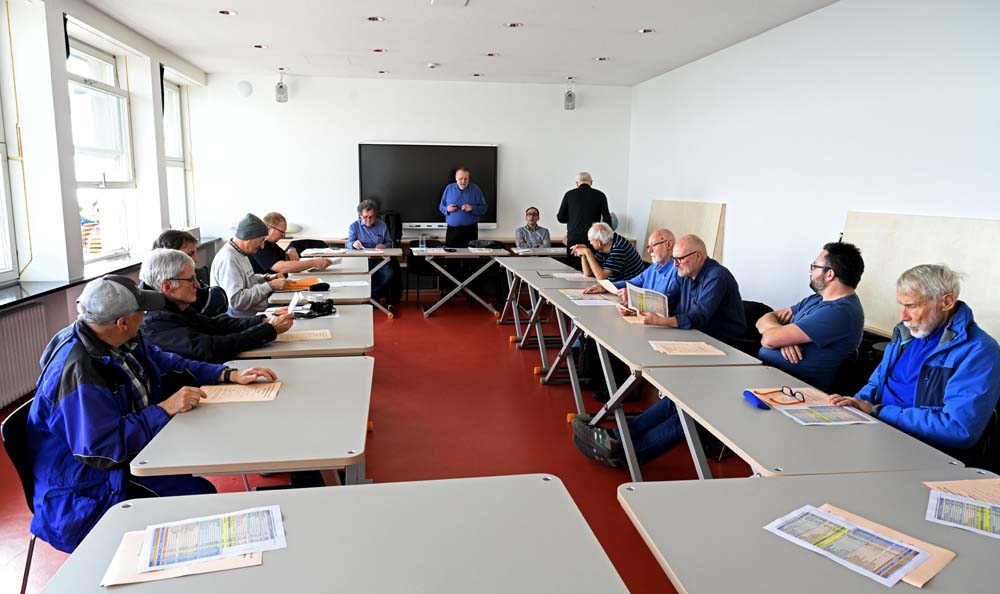 Focused participants at the AGM in a room with a wonderful view of and across Lake Constance (if only the visibility had been better…). 7 March 2026 Photo: © Edi Meier, Bülach
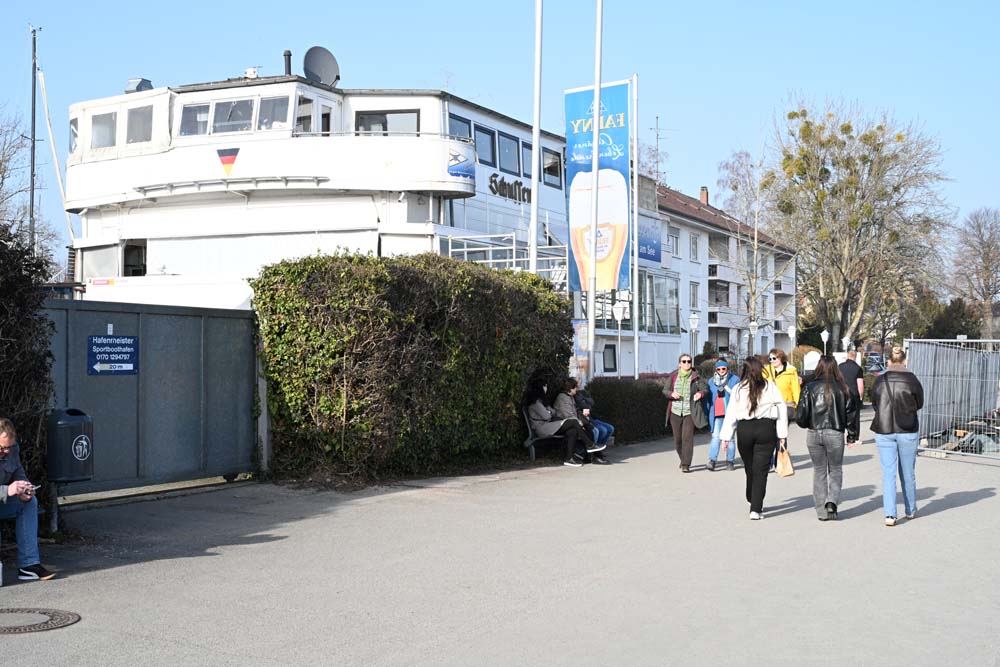 nyone who took a short stroll along the lakeside promenade might have come across the sad remains of the last railway ferry, which now serves as an event venue… 7 March 2026 Photo: © Edi Meier, Bülach