The railway line from Vallorbe via Le Pont to Le Brassus is unique in many respects. While the steep section from Vallorbe via the Le Day junction to Le Pont was owned by the SBB, the flatter section from Le Pont to Le Brassus belonged to the private railway company PBr (Pont Le Brassus). The entire line had been operated by SBB for years, and special vehicles were frequently used, as was the case during my visit on 4 February 1985.
The De 4/4 1669 – 1671 originally belonged to a series of 25 vehicles (1661 – 1684, 1685) with wooden bodies, which were built in 1927/28 by SIG, SWS and SAAS for suburban transport. We already encountered the last unit built, 1685, with different electrical equipment from MFO, in the railway history of the Be 4/4 12001.
Between 1930 and 1932, vehicles 1661–1668 used in the Seetal valley were given a new gear ratio, which reduced their maximum speed from 85 to 75 km/h but increased their tractive force from just under 6 to 7 tonnes per wheel. At the same time, an electric recuperation brake from MFO was installed. In 1939, the same conversion was carried out on the three railcars 1669–1671 used on the PBr, but with a different circuit for the electric recuperation brake.
Between 1948 and 1958, all vehicles were fitted with new traction motors from SAAS, while the thrifty SBB continued to use the old motors for the Tem III 321–365 shunting tractors. Between 1966 and 1971, vehicles 1661 to 1671 were fitted with new steel bodies at the main workshop in Yverdon. Vehicles 1672 to 1685 remained unchanged. With the exception of the first converted vehicle, 1669, which was delivered in SBB green, all converted vehicles were painted red. The green 1669 also turned red in 1977.
The corresponding control cars also originated from a conversion project. Between 1961 and 1964, the Zurich workshop built seven BDti control cars on old underframes and, between 1963 and 1965, nine Bti cars with new steel bodies. Control car no. 903 was usually in service on the PBr line. However, the open platforms were unsuitable in the cold and often snow-covered Jura high valley (La Brévine, the Siberia of Switzerland, is very close by…). Snow and ice posed a danger when getting on and off, and the single door between the platform and the passenger compartment offered little protection from the cold and a lot of draughts. For this reason, in 1981, the open platform on the Bt 903 was closed, making it the only one in the series with this feature, and the car was given a red paint job to match the railcars.
I photographed the passenger trains in this configuration on 4 February 1985. The high valley had little snow for the season on that day.
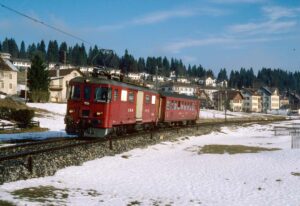 De 4/4 1669 and Bt 903 shortly after the Chez le Maître stop, which belongs to Le Sentier. Le Sentier is a long, stretched-out street village whose last houses form the backdrop behind the train and are built in the typical style of the area.
Note also the «wind-inclined» catenary, a cost-effective design for branch lines. 4 February 1985 photo: © Edi Meier, Bülach
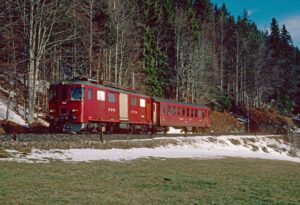 De 4/4 1669 and Bt 903 at Le Sentier. Here, the line runs parallel to the lake (Lac de Joux) for a short distance to Le Pont and climbs slightly. 4 February 1985 photo: © Edi Meier, Bülach
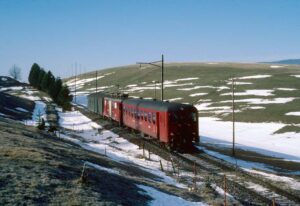 Bt 903 and De 4/4 1669 plus Z 33 831 near Les Charbonnières. The sun is low, which is why even small shrubs cast long shadows. The train is reinforced with the Z 33 831 mail car. 4 February 1985 photo: © Edi Meier, Bülach
 As a supplement, here is a well-known photo by Rainer Siegenthaler, which appears on the home page of our website, alternating with other photos. It shows the same De 4/4 1669 in green livery in front of the Vallorbe depot. photo: © Rainer Siegenthaler, Bülach @ bahnarchiv.ch
Comments and additions to this railway history can be sent to EG at sgeg dot ch, or use the form to our Vice President Edi Meier. Thank you for your help.
Back to railway stories.